


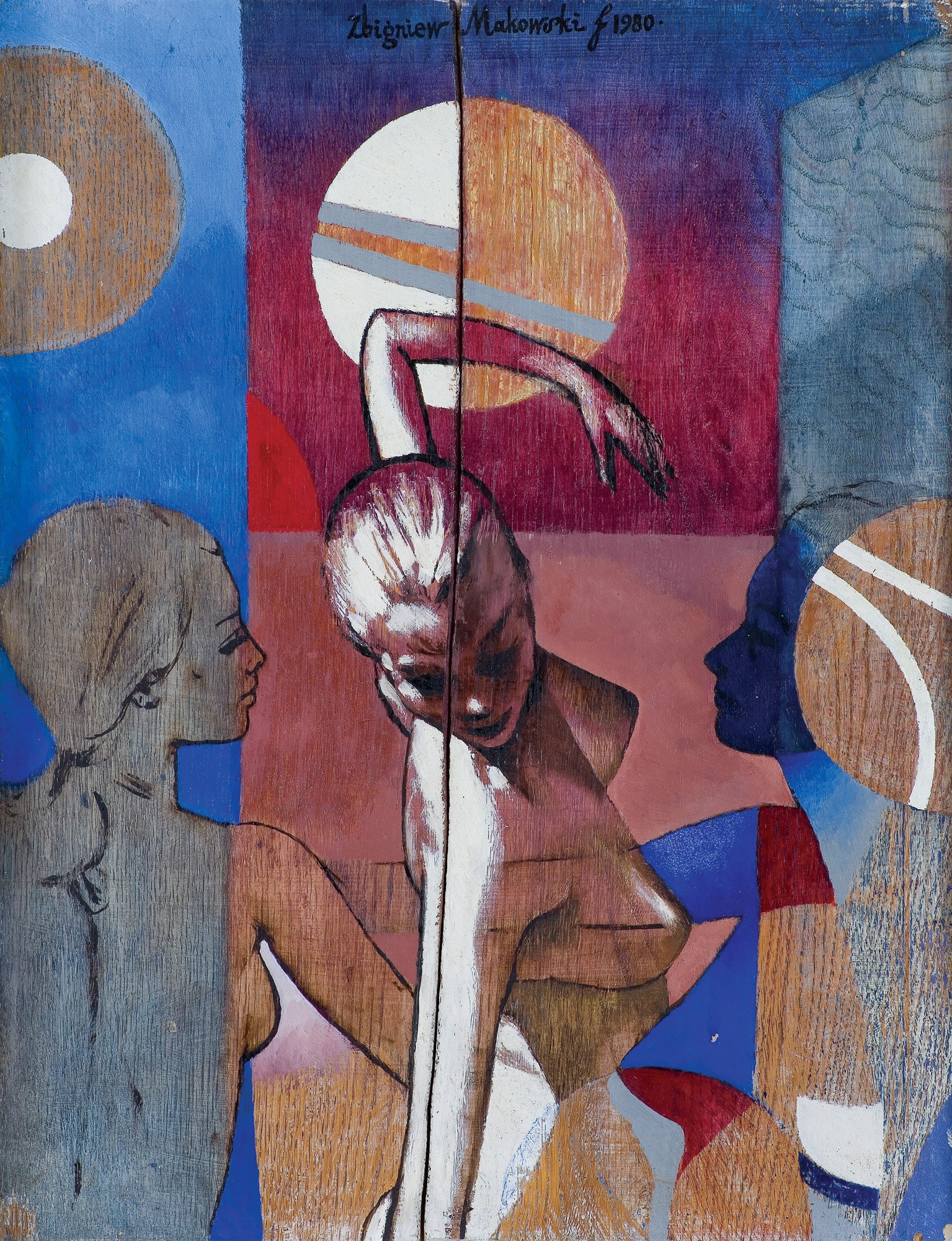
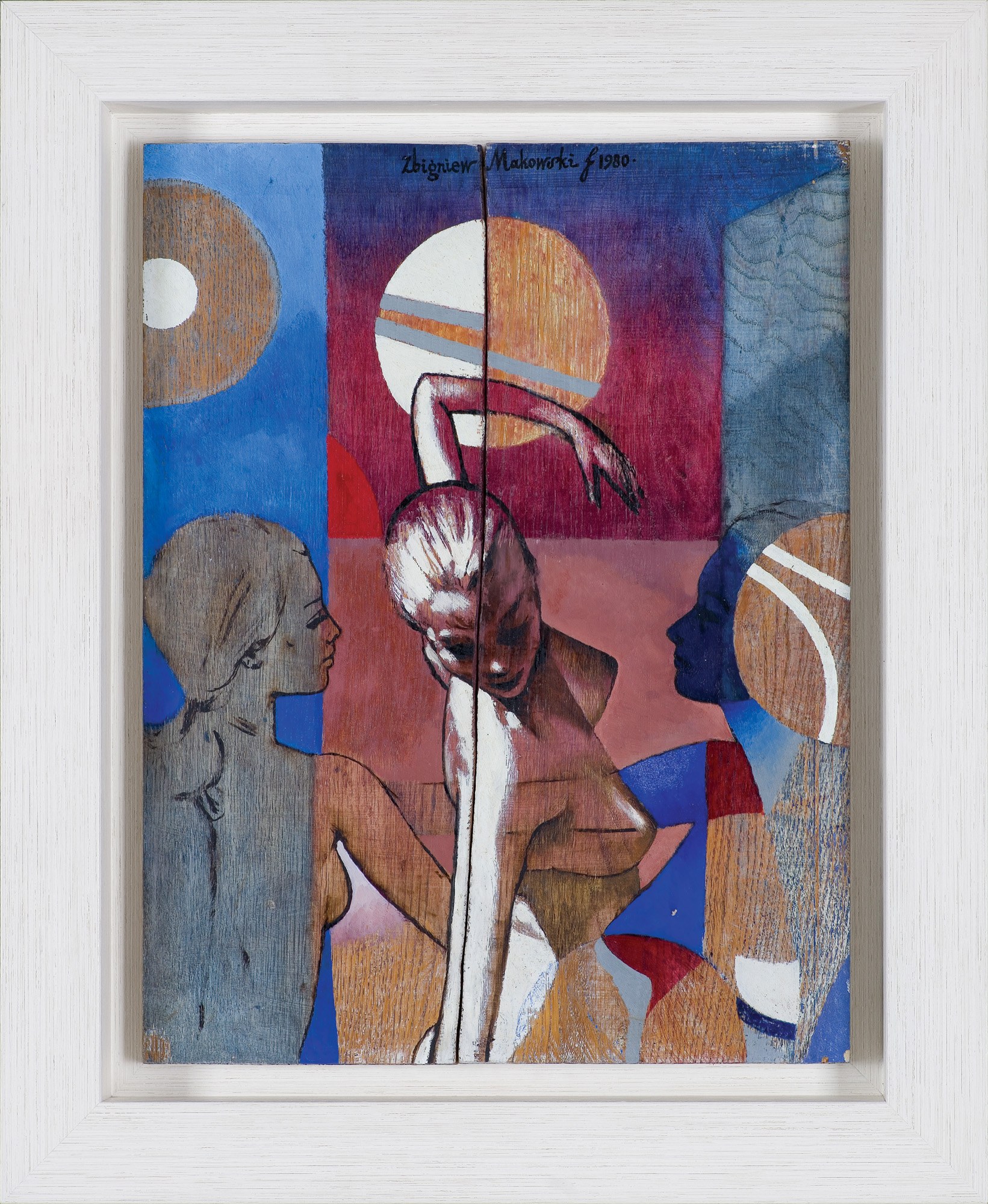
50 x 38.5 cm - tempera, oil, two joined boards
Signed below: Zbigniew Makowski f 1980.
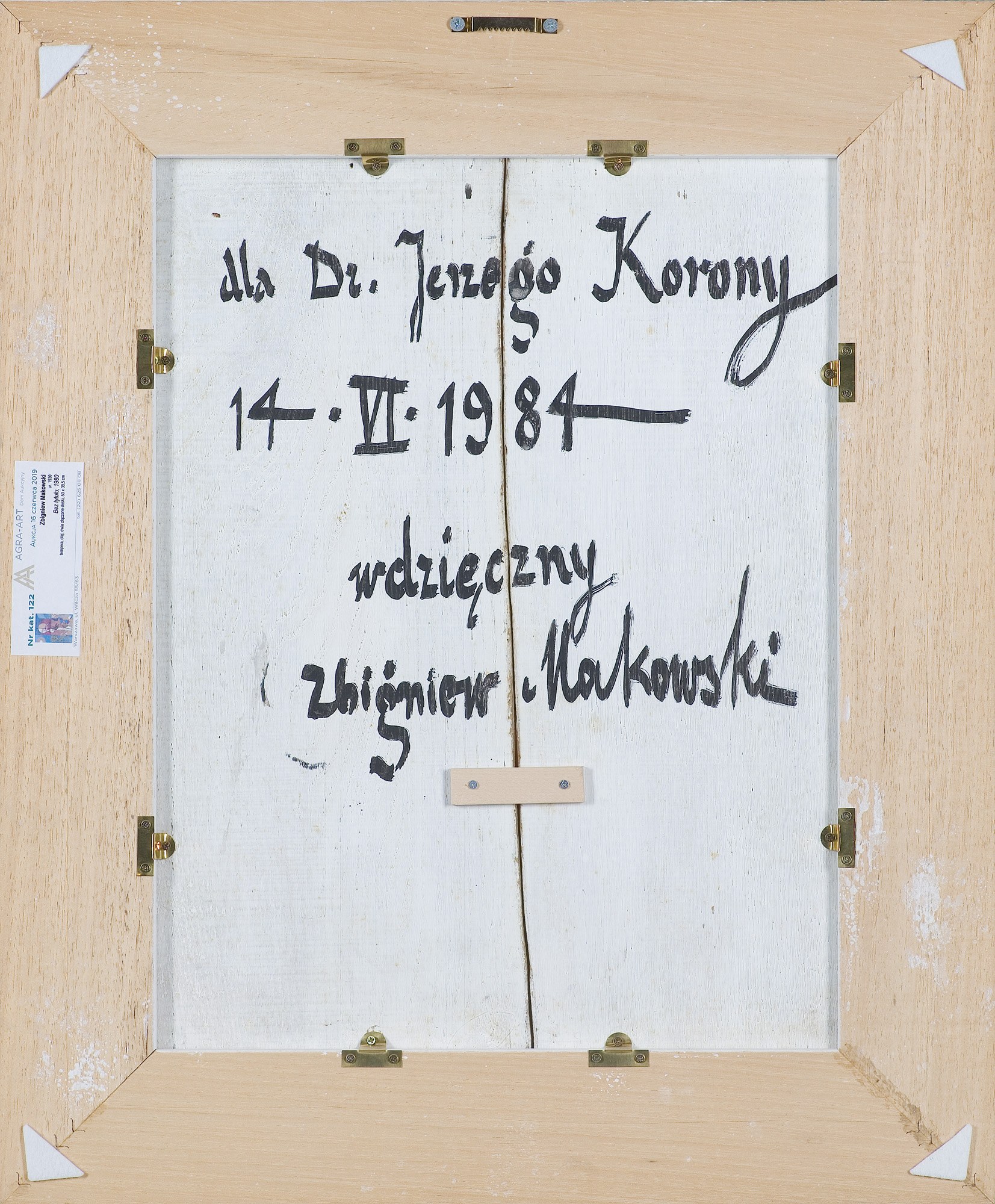
Signed on back: for Dz. Jerzy Korona | 14. VI. 1984 | grateful | Zbigniew Makowski
In Zbigniew Makowski's work of the 1980s, next to the geometric forms recurring in his work, which are linked to inscriptions, the human figure, especially female figures, becomes a new and dominant element.
One of the researchers of Zbigniew Makowski's work, Krystyna Bartnik, wrote the following about the painter's paintings from that time: Female figures gradually appear in his works with increasing frequency, such as Kirke, Helena, Pargoletta - painted and drawn personifications of the anime, the ideal of woman existing in the male subconscious, or the feminine aspect of the male psyche, a metaphor for the deepest psychic powers. Often appears the name Maria, which can be perceived both in the context of a Christian myth, and the Jungian third phase, after Eve and Helen, of the development of the anima in the process of male individuation (manifested in religious feelings and lasting relationships), or a close person. (...) The painter tries to reach an archetype, a non-temporal pattern based on multiple images. There is an increase in the sensuality of the image and even a sensual feeling of color, vivid, joyful, refined. (Krystyna Bartnik, Zbigniew Makowski, Wroclaw 2008, p. 11)
♣ Droit de suite: ♣ An additional fee will be added to the Purchase Price based on the right of the creator and his heirs to receive remuneration in accordance with the Law of February 4, 1994 - on Copyright and Related Rights (droit de suite).
Zbigniew Makowski (Warsaw, 31 I 1930 - Warsaw, August 19, 2019) studied at the Academy of Fine Arts in Warsaw from 1950 to 1956, receiving his diploma in the studio of Kazimierz Tomorowicz. Initially he leaned towards Surrealism - during his stay in Paris in 1962 he came into contact with André Breton and the international Phases movement. However, the decisive influence on the expression of his art came from the non-painterly interests he pursued. He is literate, poetic, erudite, especially an expert in the broad spectrum of philosophy and secret knowledge of many cultures. He uses this expertise in his paintings, drawings, as well as in unique books, which he makes with his own hands on specially prepared papers. In his works he layers symbols, quotations and meanings into a seemingly unreadable chaos. However, one should believe critics who claim that Makowski's works open up a world of peculiar narrative to the patient and intellectually prepared "reader." In turn, the artist himself draws attention to the "permutation" structure of his works, in which various quotations and cultural references are intertwined with his private iconography. Be that as it may, it is certainly possible to distinguish a certain visual-symbolic "alphabet" in Makowski's works, the elements of which constantly appear in them in various configurations. These include, for example, such images as a key, ladder, well, mandala, chalice, etc. They are surrounded by inscriptions, often in Latin, as well as single numbers, letters and ornaments. Someone described them as rebuses of great beauty, which can be read, and can also be contemplated. Since 1982, the artist stopped exhibiting, but not creating. At that time, works were created that were a kind of modern notebook, started back in the 1960s, to which the artist returns with new thoughts. The artist is the recipient of many awards, including the Norwid Art Criticism Award (1973) and the Jan Cybis Award (1992). His large composition "Mirabilitas secundum diversos modos exire potest a rebus" (1973-1980) adorns the Geneva headquarters of the United Nations as a gift from the Polish government.













Vizualizate recent
Loghează-te pentru vedea lista loturilor
Preferate
Loghează-te pentru vedea lista loturilor