


[WARSAW — Statue of Christ on the steps of the Church of the Holy Cross — panoramic photograph]. [1925]. Photograph, size 15.8x11.5 cm, by JanBułhak in Vilnius.
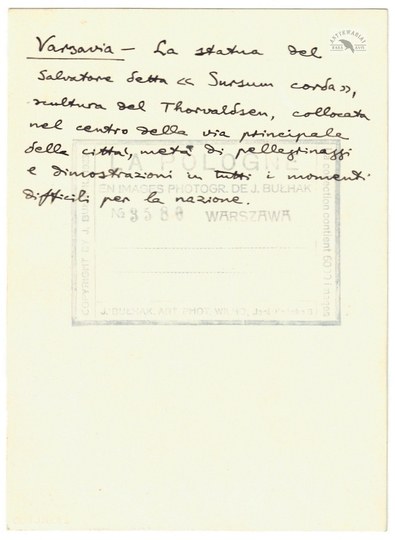
A view of the famous statue of Christ carrying the cross, located on the steps in front of the Basilica of the Holy Cross in Warsaw on Krakowskie Przedmieście Street. In the lower right corner, an imprint reads: “J. Bułhak Vilnius.” The photograph is part of the author’s series “Poland in the Photographs of Jan Bułhak.” On the reverse, a stamp reads: “LA POLOGNE en images photogr. de J. Bułhak. No. 3580 WARSAW / J. Bułhak. Photo by J. Bułhak, Vilnius, Jagiellońska 8 / The collection contains 6,000 images / Copyright by J. Bułhak, Vilnius 1925" and a handwritten identification in ink, in Italian. In very good condition.
The Monument to Christ Carrying the Cross, which stands in front of the facade of the Basilica of the Holy Cross in Warsaw. The sculpture strikingly combines art, Polish history, and extraordinary symbolism. The original cement sculpture, designed by Andrzej Pruszyński, was erected at this site in 1858 on the initiative of Count Andrzej Zamoyski. Due to vandalism that damaged the original, a bronze cast was made in Rome in 1898 under the supervision of Pius Weloński. Weloński signed the sculpture, though Pruszyński remained the creator of the original model. The granite pedestal, added in 1898, was designed by Stefan Szyller. It was on this pedestal that the gilded inscription “Sursum Corda” (Latin for “Lift up your hearts”) was placed. During the Warsaw Uprising in September 1944, as a result of German shelling, the monument fell onto the street. The figure came to rest on the cobblestones in a remarkable way: the reclining Jesus pointed directly with his right hand toward the inscription carved on the pedestal. Taken away by the Germans in 1944 to be melted down, the statue was found in a roadside ditch in Hajduki Nyskie and finally returned to Krakowskie Przedmieście in 1945. (AI).
J. Bułhak (1876–1950)—an outstanding Polish photographer, the doyen of Polish photography, a philosopher and theorist, founder of the Vilnius Photo Club in 1927, and co-founder of the Association of Polish Art Photographers (ZPAF) after World War II. He established his first studio at the urging of Ferdynand Ruszczyc. For a time, he worked at Hugo Erfurt’s studio in Dresden. His first works in Vilnius were created between 1912 and 1919 and were devoted mainly to landscapes and monumental architecture. It was precisely these themes that became central to his work, and he focused primarily on them for the rest of his life. He was a pioneer of landscape photography. His collection of approximately 10,000 photographs, titled “Poland in Photographic Landscapes,” and his archive of Polish and foreign photographs were destroyed by fire in Vilnius in 1944. After the war, until 1946, he took approximately 1,000 photographs documenting the destruction and reconstruction of Warsaw and approximately 2,000 photographs from the Eastern Territories. He published numerous albums, portfolios, and postcards featuring photographs, mainly from the Eastern Borderlands and especially those depicting the Vilnius region. He was also the author of many textbooks on the aesthetics and technique of photography and regional studies, as well as the initiator of historical research on photography.











Vizualizate recent
Loghează-te pentru vedea lista loturilor
Preferate
Loghează-te pentru vedea lista loturilor