


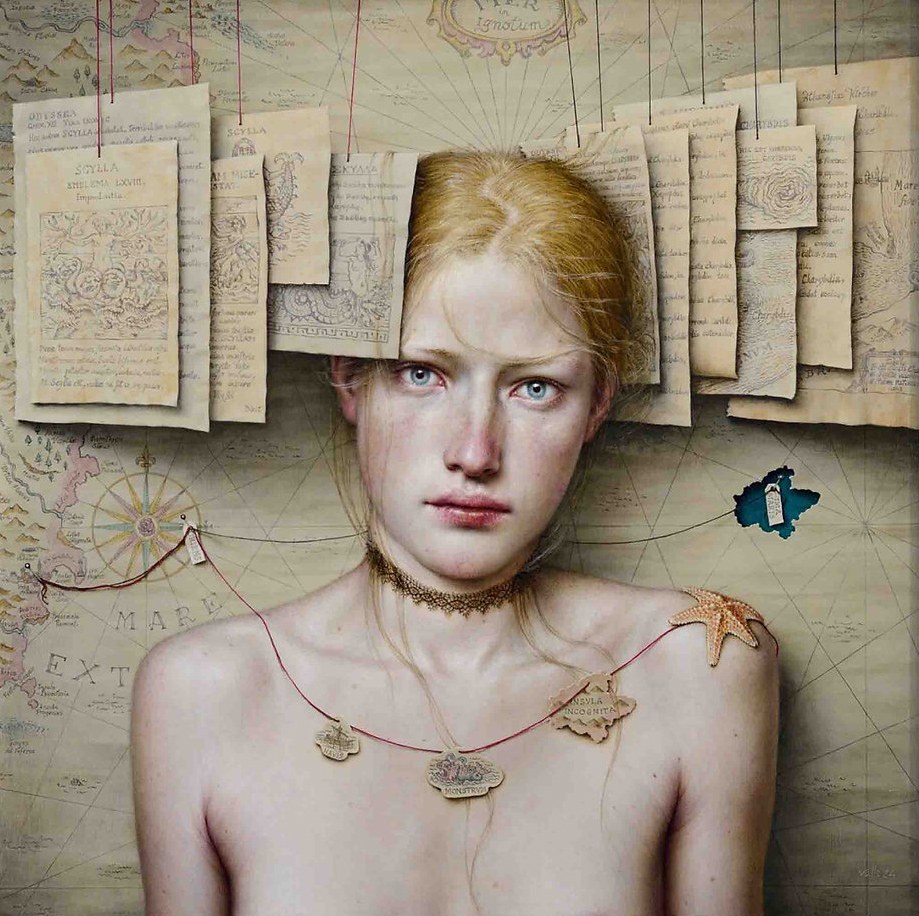
The title ITER means "journey" in Latin.
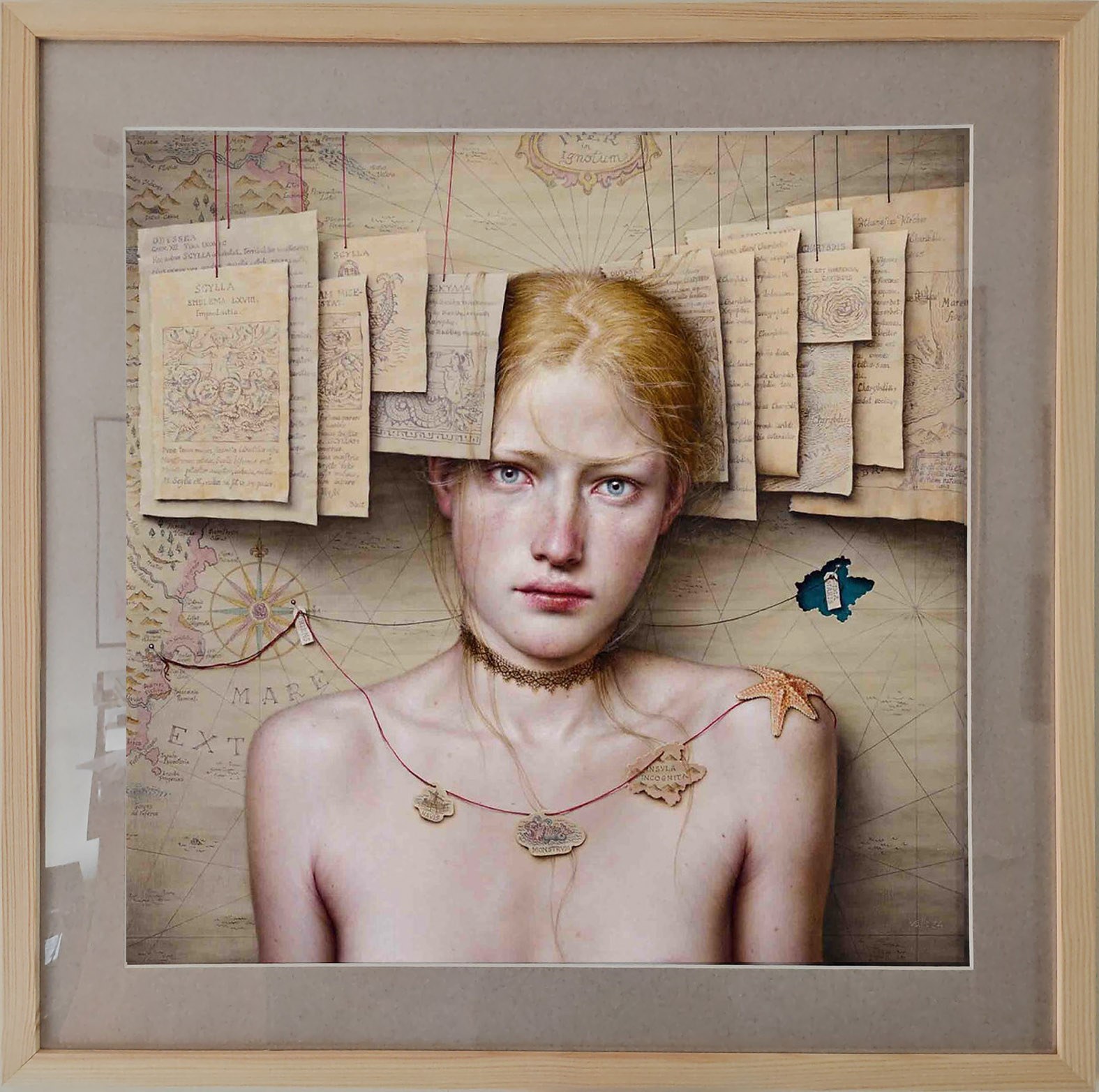
The figure stands against a background of an ancient portolan map with the inscription ITER in Ignotum - "journey into the unknown." On either side of the head hang pages from old books, referring to the mythological monsters Scylla and Charybdis. This motif, present in Homer 's Odyssey, symbolizes the choice between two dangers.
Red and black threads connect the map to the heroine's body, indicating the psychological journey and tension between the extremes. The nautical star and suspended plaques emphasize the motif of wandering and the balancing between danger and the chance of rescue.
The artist juxtaposes ancient, medieval and Renaissance traditions (texts by Alciatus, Aeneas, Kircher, Homer) with his own symbolism. In psychological terms, the map and the journey to the east symbolize the process of individualization and the search for identity - a risky but necessary task to discover oneself.
Art printmaking
Dimensions: 50 x 50 cm, 63 x 63 cm (with frame)
Dino Valls was born in 1959 in Zaragoza, Spain, and after graduating from medical school (Medicina y Cirugía, Universidad de Zaragoza, 1982), he devoted himself entirely to art. He was passionate about drawing from childhood, and began to paint in oils on his own in 1975.
In the 1990s, his interest in old-master techniques - especially egg tempera - as well as the techniques of layering, velatur, and the influence of Italian and Flemish masters of the 15th-17th centuries, is developed and modified by him in characteristic ways.
Valls' works are characterized by deep psychological symbolism, exploring themes of the subconscious, corporeality, wounding and beauty, often with the presence of portrait, allegorical and metaphorical motifs.
Dino Valls currently lives and works in Madrid. His work has been presented in numerous solo and group exhibitions - in Spain and abroad. The artist's works can be found in galleries in private and museum collections around the world.










