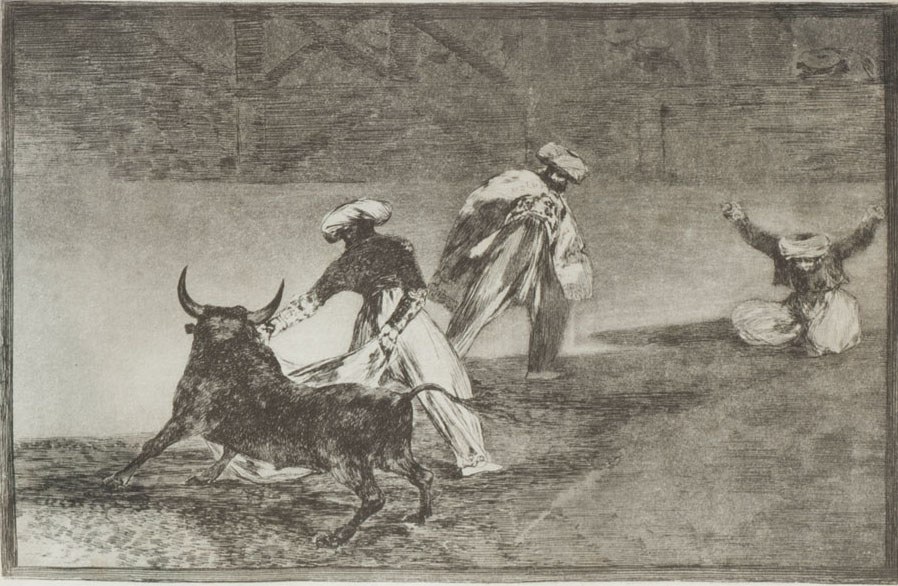
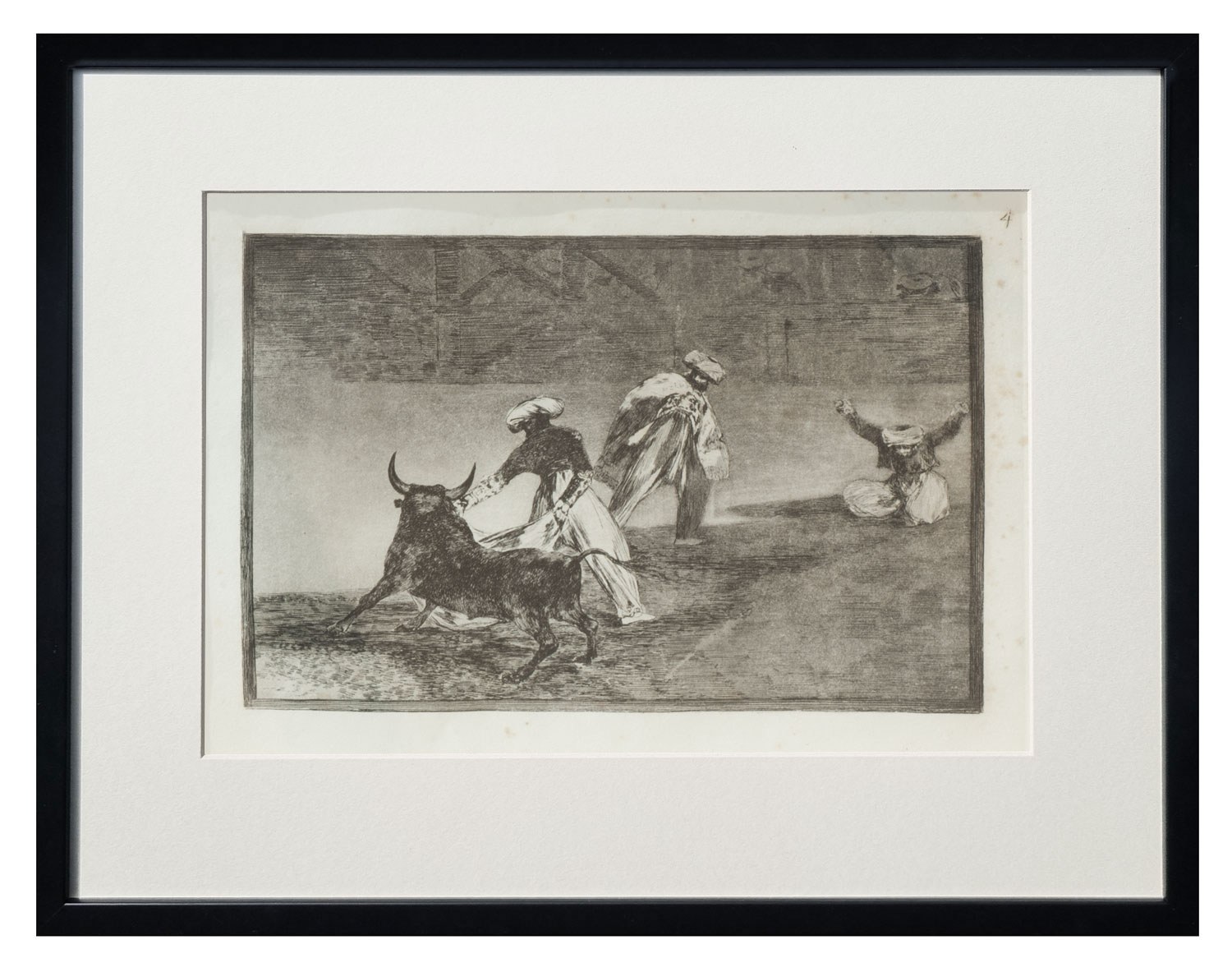
Etching and aquatint on handmade paper.
Plate 4 from the series "La Tauromaquia." Print made from the original plate in Madrid, ca. 1850.
Dimensions with frame: 40x50 cm; print size: 24.5x33.5 cm
Francisco José de Goya y Lucientes (Fuendetodos 1746 – 1828 Bordeaux) – Spanish painter, printmaker, and draftsman of the Romantic period; court painter to Charles III of Bourbon, Charles IV of Bourbon, and Ferdinand VII of Bourbon; portraitist and painter of genre scenes. Considered one of the most outstanding and original artists of the late 18th and early 19th centuries. Goya’s artistic career spanned roughly from 1771, when he painted his first fresco in the Basilica del Pilar in Zaragoza, to 1827, when he created one of his last works, *The Milkmaid of Bordeaux*. Over the course of more than half a century of his professional career, he produced approximately 700 paintings, 280 prints, and about a thousand drawings. As he developed his own unique style, Goya evolved from the Baroque and Rococo styles—which permeate his early frescoes and tapestry designs—through Neoclassical academicism to the Pre-Romantic and Pre-Impressionist tendencies evident in his later paintings and prints. The result of his liberation from classical rules and the culmination of his artistic expression is a series of black paintings. The range of themes he explored is very broad, including portraits, genre scenes (hunts, folk scenes, social vices, violence, witches, and superstitions), historical and religious paintings, and still lifes. Given the number and quality of the works, the collection held at the Prado Museum in Madrid is particularly significant. The artist is also widely represented in various museums around the world, especially through his portraits. His works can be viewed at the National Gallery in London, the Metropolitan Museum of Art in New York, the Uffizi Gallery in Florence, the Alte Pinakothek in Munich, and many others.