


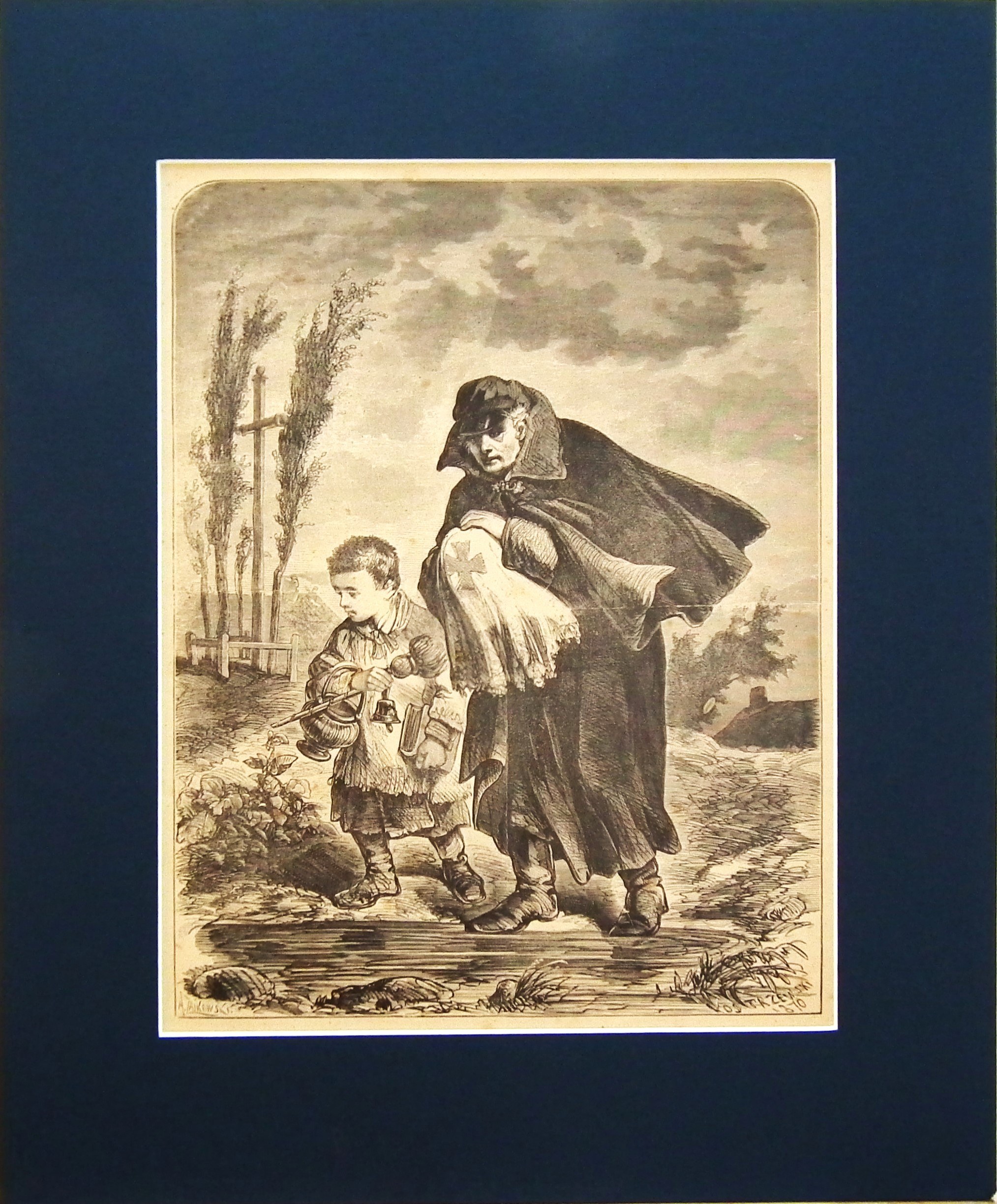
Woodcut, paper, 32 x 25 cm (inside the mat),
signed and dated on the block, lower right: 'F. Kostrzewski 1870,' and by the woodcut artist, lower left: A. Zajkowski;
from the portfolio “Album Fr. Kostrzewskiego,” published by S. Lewental, 1893.
Franciszek Kostrzewski—realist painter, creator of genre scenes, illustrator, satirical cartoonist, and caricaturist. He was the son of the steward of one of the noble palaces in Warsaw.
After the November Uprising, the family moved to a country estate in the Sandomierz Province, while Franciszek returned to Warsaw to continue his education. However, after completing the fifth grade of middle school, he lost interest in his studies; from a very young age, he had been passionate above all else about drawing and studying nature. His father opposed his plans to pursue art, but in 1844, the 18-year-old Kostrzewski enrolled in the newly established School of Fine Arts in Warsaw. He studied under, among others, Jan Feliks Piwarski, Chrystian Breslauer, and Aleksander Kokular. During his studies, he traveled throughout the country, painting landscapes and genre scenes that documented life in small towns of that era.
In 1856, he spent several months in Paris. Upon his return to Poland in 1856, he began working as an illustrator. His illustrations appeared in Warsaw magazines, and he also illustrated books.
Franciszek Kostrzewski is the author of one of the oldest Polish comic strips. It was *The Story of the Only Child in 32 Pictures*, the first installment of which appeared in the third issue of *Tygodnik Ilustrowany* on October 3, 1859. Kostrzewski is considered the pioneer of the Polish comic strip.
Andrzej Zajkowski (born 1851 in Warsaw, died November 28, 1914, there) – an outstanding Warsaw woodcut artist, one of the leading figures in Polish xylography, and an excellent interpreter of Michał Andriolli’s drawings.
Active from 1865 to 1889, he gained recognition in artistic circles at an early age. His works began to appear in *Kłosy* when he was not yet 15 years old; by the age of 20, he was engraving Andriolli’s drawings, with whom he collaborated the longest (one of Zajkowski’s last works, titled *Koncert nad koncertami*, was based on an Andriolli drawing). In 1881, he was commissioned to create woodcuts based on Andriolli’s drawings for Adam Mickiewicz’s *Pan Tadeusz* (published in Lviv in 1882). In addition to Andriolli, Zajkowski engraved works by other outstanding painters and draftsmen (including Józef Chełmoński, Józef Buchbinder, Wojciech Gerson, Julian Fałat, Apoloniusz Kędzierski, Juliusz Kossak, Franciszek Kostrzewski, Jan Matejko, Józef Pankiewicz, Henryk Pillati, Władysław Szerner, Leon Wyczółkowski, and many others). In 1876, he founded a short-lived woodcut workshop with Jan Styfi. He received numerous awards for his artistic achievements, including at the Ornamental Art Exhibitions in Warsaw in 1886–1888 and the Printing Art Exhibition in St. Petersburg in 1895.










Vizualizate recent
Loghează-te pentru vedea lista loturilor
Preferate
Loghează-te pentru vedea lista loturilor