Maurice Utrillo (1883-1955)
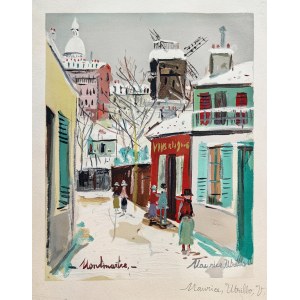
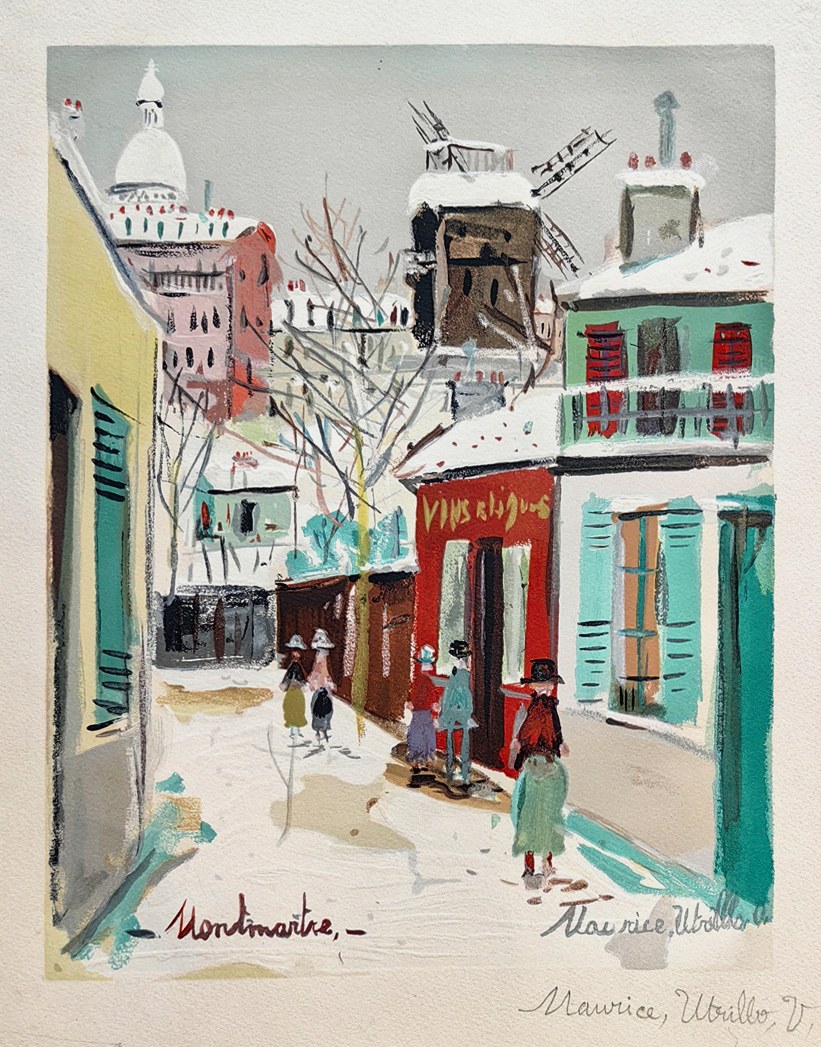
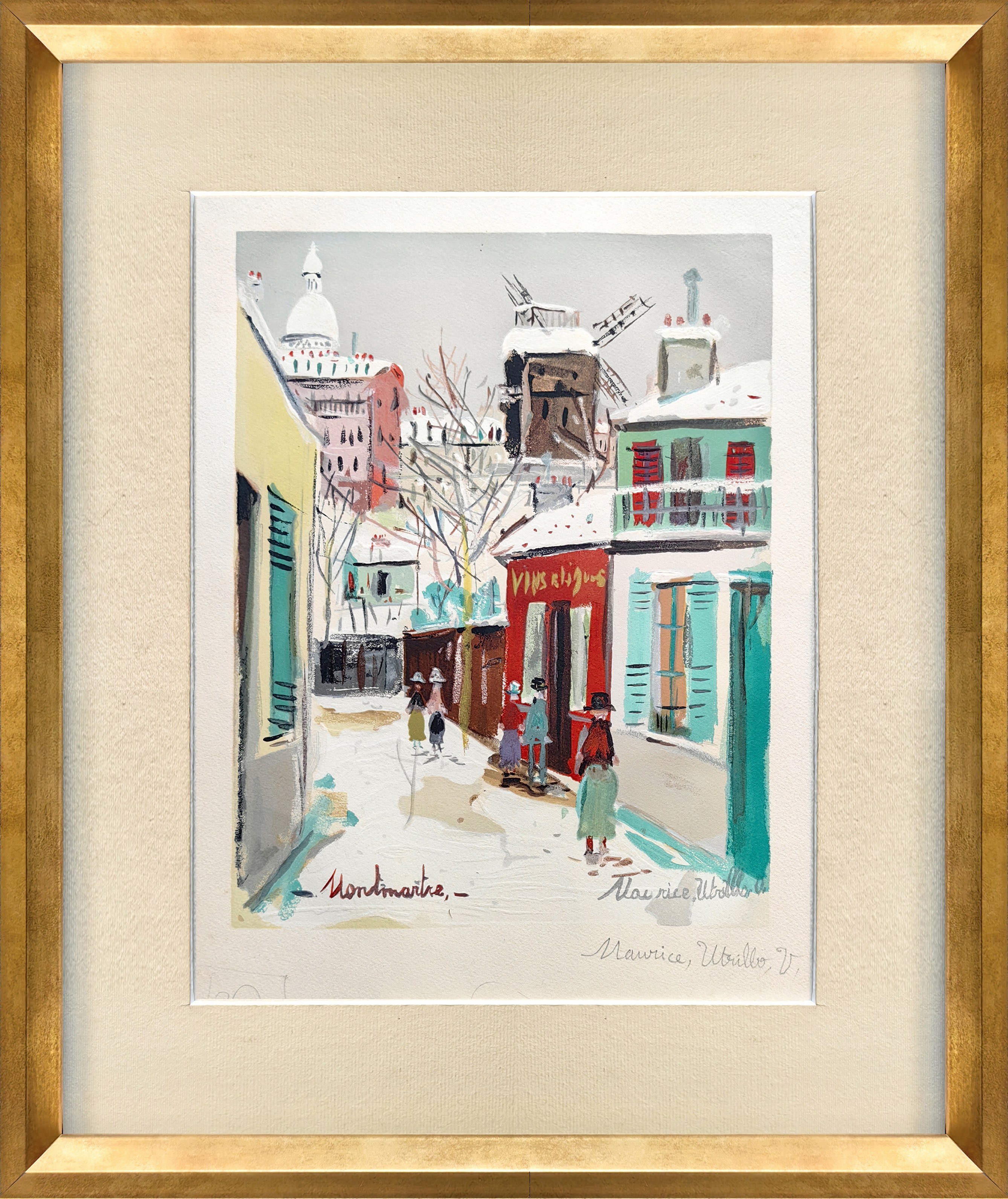
Title: Le Moulin de la Galette
Year: 1947
Technique: Color lithograph on Mourlot paper
Dimensions: in st p-p: 32 × 25 cm, 45 x 38 cm (with frame)
Signature: signature in plate (printed);
additional marking in pencil "Maurice Utrillo V." (facsimile)
Edition: 240 pieces
Provenance: One of 22 lithographs illustrating the book Montmartre vécu par Utrillo by Francis Carco, published in 1947.
Description:
The work on offer depicts a winter view of Montmartre with the distinctive "Moulin de la Galette" mill in the background - a motif that often appears in the work of Maurice Utrillo.
The lithograph was commissioned by the publisher at the famous Atelier Mourlot in Paris, known for its collaborations with some of the greatest artists of the 20th century.
The work comes from a limited edition of 240 pieces and is characterized by high quality printing and hand coloring using the pochoir technique, which gives it a unique, painterly character.
Condition: very good; minimal traces of paper aging in the margins.
Maurice Utrillo, owner of Maurice Valadon (1883-1955) - French painter and printmaker, representative of the École de Paris.
He was the illegitimate son of the artist and model Suzanne Valadon. At the age of 7 he was adopted by Catalan art critic Migueal Utrillo y Molina. Alhokolik since childhood, he was a gypsy wandering between Montmartre's pubs and sobering chambers and mental hospitals.
He began painting as part of therapy to combat alcoholism at the age of 18. By 1903 he had already painted hundreds of views of the Parisian suburb of Montmagny. His first paintings betray the influence of Camille Pissarr and Alfred Sisley (the so-called Montmagny period). In 1909, his painting was included in the Autumn Salon. At this time, he stopped creating outdoors in an impressionistic manner and began painting from postcards. He concentrated on depicting white buildings with glue, plaster and white paint. His most outstanding paintings were created then. (The so-called white period 1908-14). The next phase of his oeuvre is characterized by bright colors and a greater emphasis on line, as well as a new subject: women walking on the street seen with their backs to the viewer (the so-called cloisonné period 1914-20). After 1920, he created paintings that were multicolored but of lesser artistic merit (the so-called cloisonné period).
In 1912 he participated in an exhibition of French art in Munich. In 1913 he had his first solo exhibition. In 1924, due to a progressive alcoholic disease, he was imprisoned and attempted suicide. In 1928 he was awarded the Legion of Honor. In 1935 he married Lucie Valore, a French actress who had previously been friends with his mother.
He was an extremely prolific painter. During World War I alone, he painted 1,200 oil paintings. A posthumous catalog of his works lists more than 3,500 paintings. The main theme of his works became the cityscape (narrow, poor streets, backstreets of Paris, gray walls, small towns, provincial churches). He also painted portraits and still lifes. He was sporadically involved in stage design: in 1926 he made decorations for Sergei Diaghilev's Russian Ballets company, and in 1948 he worked with the Comédie Opera in Paris. He died of pneumonia.