


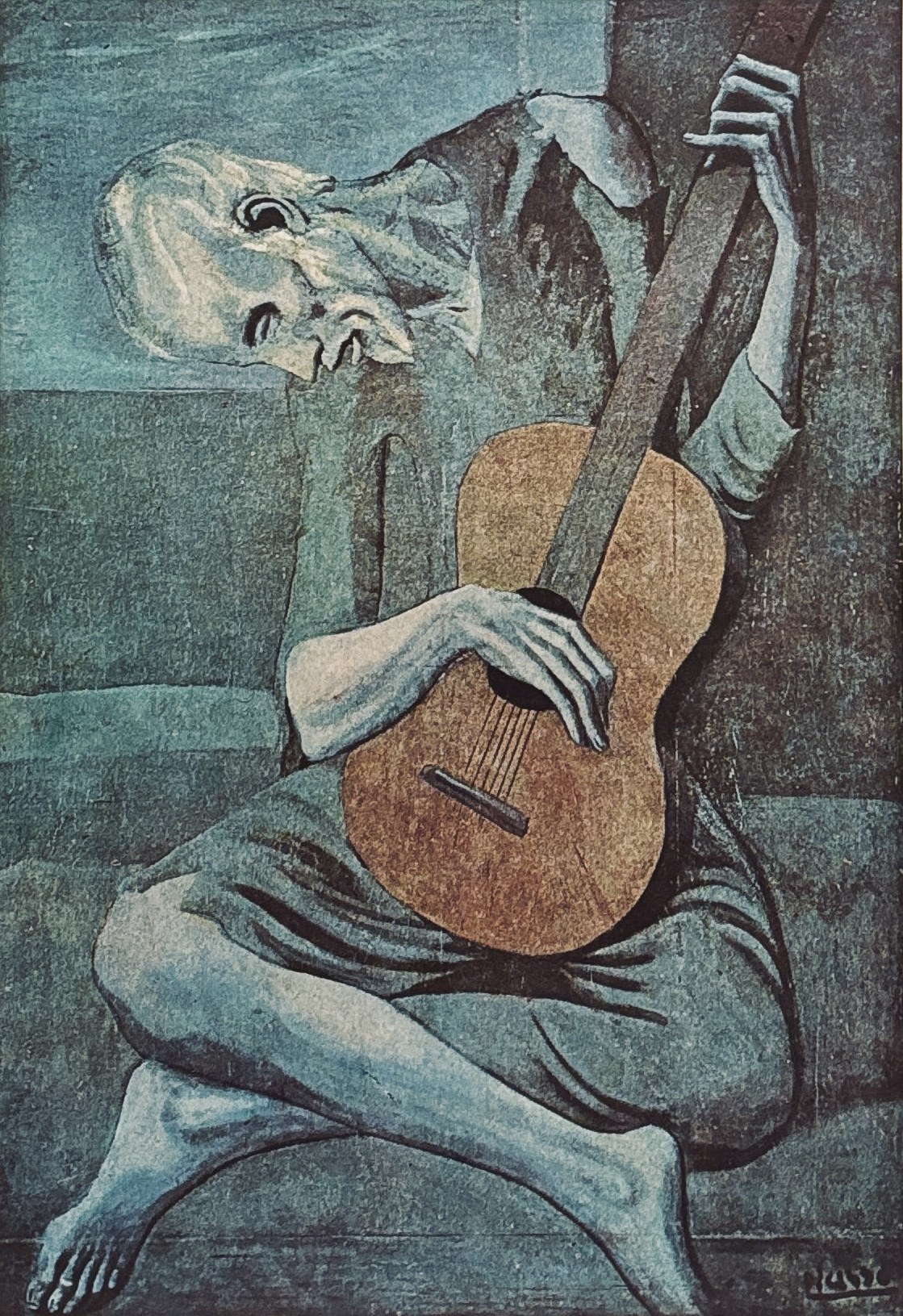

Workshop lithograph, satin paper, 47 x 32 cm, in light passe - partout of 57 x 42 cm.
Publisher Centro Diffusione Cultura Milano.
On the reverse of the stamp: Succ.Pablo Picasso Coll. Marina Picasso
Paper specially produced for this edition by Cartier Sterzi; edition of 1000 copies; lithographic plates were destroyed to avoid unauthorized prints.
"The Old Guitarist"(El viejo guitarrista) is one of Pablo Picasso's most iconic works from his so-called Blue Period (1901-1904).
The painting is quintessential to this phase of Picasso's work. The dominance of cool blue tones is not accidental - the color here symbolizes melancholy, deep sadness, poverty. Picasso was painting marginalized people at the time: beggars, the sick, prostitutes and orphaned children, a reflection of his own financial difficulties and his mourning over the suicide death of his friend Carlos Casagemas.
When Picasso painted "The Old Guitarist," he was struggling with poverty. After moving to Paris as a teenager, he lived in the Montmartre district in very difficult conditions. Legends circulate that in the coldest winters in Paris, Picasso had to burn his own sketches and drawings in a furnace to at least warm his small, unheated studio. His work at the time (beggars, blind people, emaciated people) was a direct reflection of the environment in which he lived and which he understood from his own experience.
The guitarist is emaciated, almost resembling a skeleton. His unnaturally stretched out body and angular lines betray the influence of El Greco painting. The most interesting element of the composition is the guitar itself. It is painted in warmer, brownish tones, which contrasts sharply with the blue of the rest of the canvas. The guitar symbolizes art, which is the only consolation for the poor man. Although he himself is close to exhaustion, the music he creates remains "alive" and gives him the strength to survive.
Picasso knew the taste of real hunger and poverty, as can be seen in his painting "The Old Guitarist," but thanks to his talent and business savvy, he became a living symbol of artistic financial success.
Unlike van Gogh, Picasso achieved gigantic commercial success during his lifetime. When he died in 1973 at the age of 91, he left behind a fortune estimated at hundreds of millions (or, by today's valuations, billions) of dollars.
The framing shown in the visuals is for illustrative purposes only and does not constitute a commercial offer.










