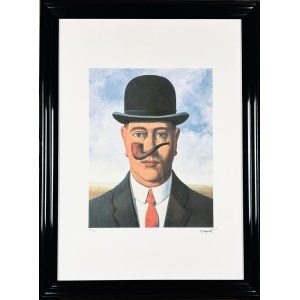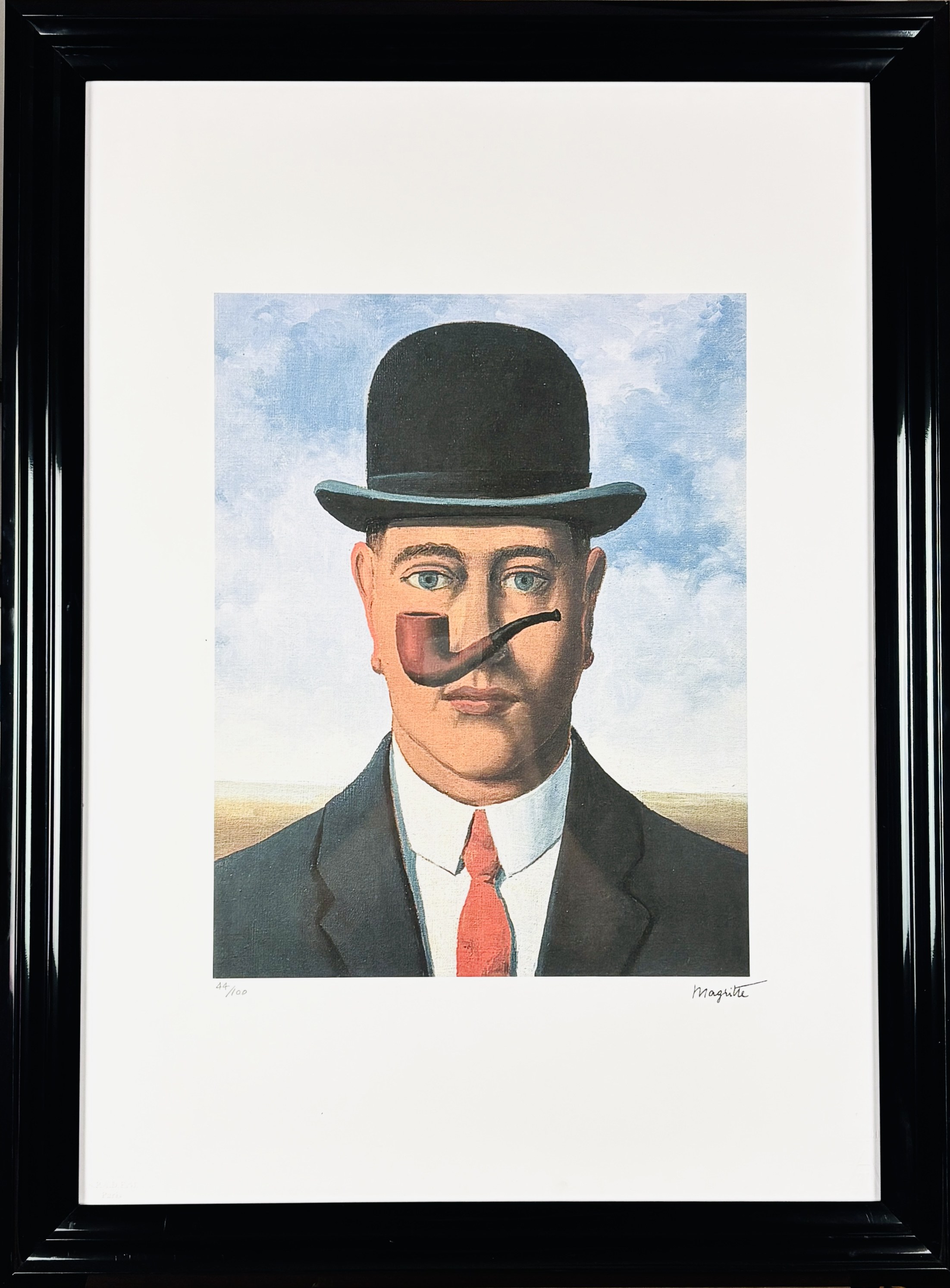

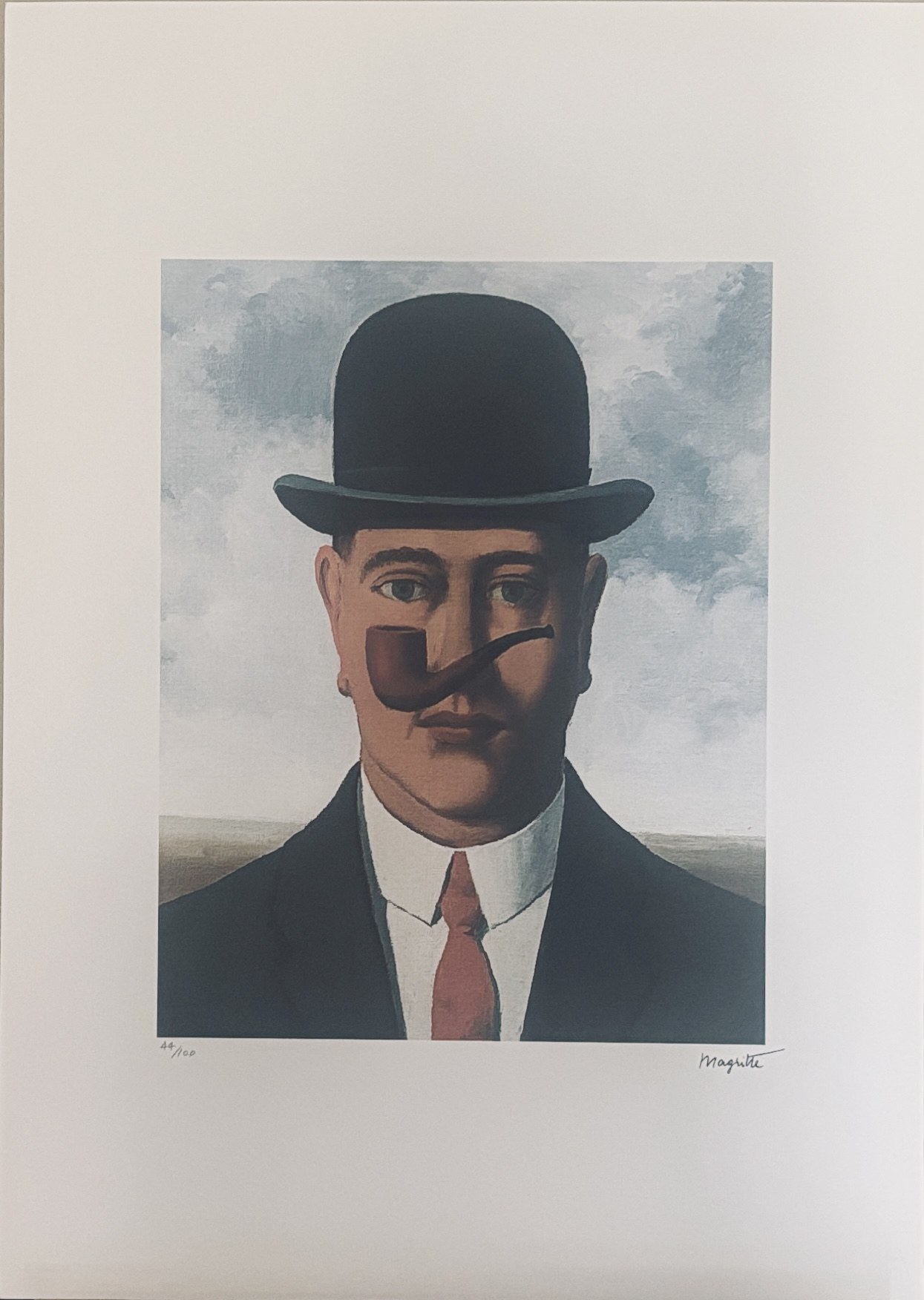
Lithograph on vellum paper, 42 x 33 cm (composition), framed in a frame measuring 78 x 58 cm
Limited edition, numbered in pencil 44/100 on the reverse
Signed from the "Magritte" plate, lower right
Dry stamp: S.P.A.D.E.M. Paris
Dry stamp of the publisher, Editioni Aro Arte
Publisher: Editioni Aro Arte
This piece bears the SPADEM Paris dry stamp and the publisher’s dry stamp, Editioni Aro Arte. The work is from a licensed edition published after the artist’s death. SPADEM (Société de la Propriété Artistique des Dessins et Modèles) was a French organization that managed the copyrights of artists and their heirs, which confirms the legal provenance of this edition.
A lithograph of an exceptionally intriguing work by René Magritte titled “Good Faith” (La bonne foi) from 1965. This work fits perfectly into the universe of the Belgian master of surrealism, while also serving as a brilliant link between his most iconic motifs.
Magritte built his career on provocation. Everyone is familiar with his 1929 painting *The Treachery of Images*, which featured a perfectly painted pipe and the caption: “Ceci n’est pas une pipe” (“This is not a pipe”). With an ironic smile, the artist reminded us then that the image of an object is not the object itself—it cannot be filled with tobacco or lit.
Toward the end of his life, in *In Good Faith*, Magritte decided to take it a step further. Instead of writing that “this is not a pipe,” he simply suspended it in midair at the level of the protagonist’s nose. The pipe not only obscures the face but actually levitates, becoming a surrealist mask.
This work is the direct, younger counterpart to Magritte’s most famous painting— *The Son ofMan* (*Le fils de l’homme*, 1964). In *The Son of Man* , the face of a bureaucrat in a bowler hat was obscured by a green apple; in *In Good Faith* (painted a year later), the mechanism is exactly the same, but the apple gives way to the aforementioned pipe.
Magritte loved this technique. He explained that everything we see always hides something else, and we subconsciously yearn desperately to see what has been hidden from us. The man in the bowler hat—the embodiment of the average, ordinary citizen (and the painter’s own alter ego, who always dressed like a civil servant)—thus becomes the enigma of all time. He is both present and completely elusive. Magritte became a pop-culture genius who ensured that these images were etched into the collective memory. This work has become a pop culture icon—featured in the film *The Thomas Crown Affair*, where a multiplied version of Magritte’s painting was used to depict figures moving to the rhythm of Nina Simone’s song “Sinnerman,” as well as in numerous parodies on *The Simpsons*. Magritte succeeded in creating an image that is both banal and deeply unsettling.
The work “La Bonne foinie” is a piece of pure surrealism, but also a symbol of one of the most stylish and brilliant plots in the history of cinema. It’s something no fan of art or good movies can ignore!