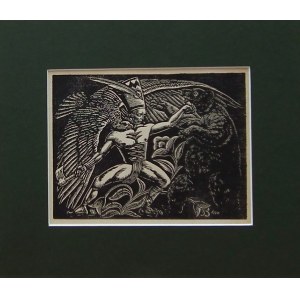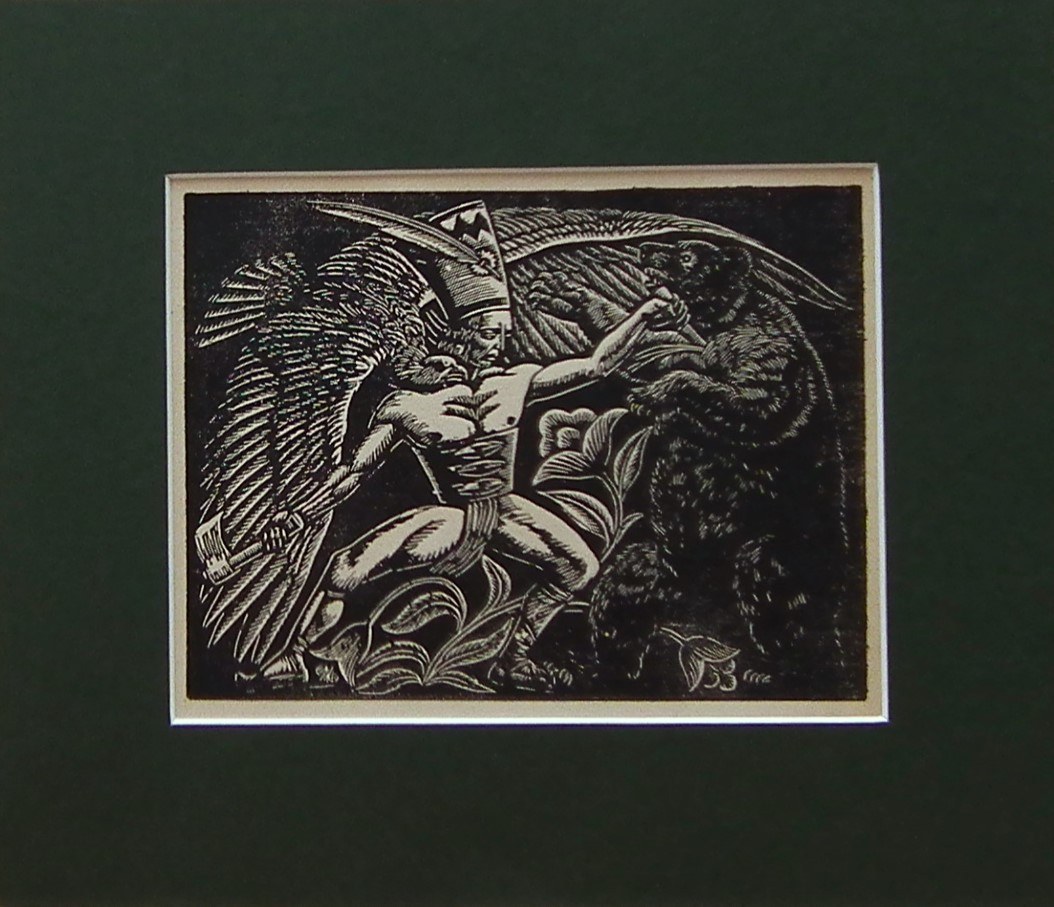
woodcut, paper 15.5 x 12.5 cm
woodcut, paper 15.5 x 12.5 cm (clear passe-partout), 25 x 22 cm (framed, passe-partout)
Wladyslaw Skoczylas was one of the most important artists ofthe interwarperiodin Poland.
He received a broad artistic education - initially he received his education in Vienna, then studied painting at the Academy of Fine Arts in Cracow. He gained additional knowledge inParis, whereheexplored the secrets ofsculpture,andin Leipzig, where heencountered woodcutting.
Skoczylas is considered by experts to be the founder of the Polish school of woodcuts, andit is for this type of work that he is best known.
Hepublisheda largepart of hiswoodcutsinthe early 1920s in the form ofalbumstitled"Tekazbójnicka" and "Tekapodhalańska". Their themesfocusedpreciselyonmountain folklore, the figure of Janosik and otherrobbers.
Afterthe end of WorldWar I ,hesettled in Warsaw, where heliveduntil his death in 1934.He hadhisstudio at WybrzezeKosciuszkowskie at number 37 - today ithouses theFaculty ofSculpture of theAcademy of Fine Arts.Skoczylas himselfwas, by the way,associated with theAcademyofFine Arts- in 1922 hetook over the chair of graphicsthere (at that time the universitywas stillcalled theSchool ofFineArts).
The artist's works won critical acclaim both at home and abroad. And so his works were exhibited in the 1920s in London, Budapest, Rome, Hamburg and Zagreb, among others. Interestingly, in 1928 Skoczylas was even awarded a medal at an exhibition held on the occasion of the Olympic Games in Amsterdam. The artist died after a long illness in 1934 and was buried in Powązki Cemetery in Warsaw.

![Władysław Skoczylas (1883-1934), Walka z niedźwiedziem, [1923] [odbitka sygnowana]](https://img1.one.bid/img/10561/3341388_1w.webp?1791544941)