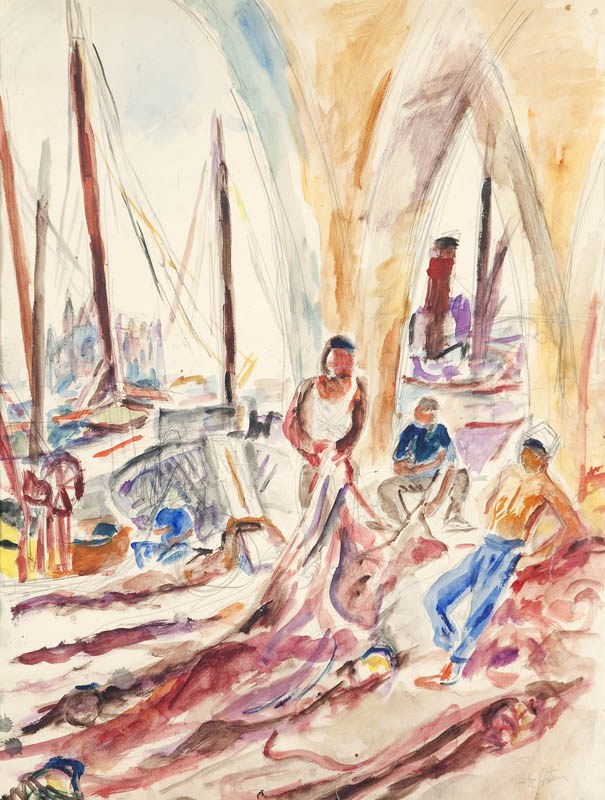
Dimensions: 62 x 47 cm
signed lower right: 'H. Epstein'
Provenance
Artcurial auction house, Paris, March 2010
Private collection, Poland
Biography
He studied painting for a time in Munich. Around 1911, he moved permanently to Paris, where he attended one of the art studios in Montparnasse. He was friends with Utrillo, Chaim Soutine, and Amedeo Modigliani. He exhibited at the Salons des Indépendants (1921–23, 1925, 1928), as well as at the Salon d’Automne in 1921 and the Salon des Tuileries from 1927 to 1931. Initially, he was primarily interested in Post-Impressionism—the Synthetism of Paul Gauguin and the École de Pont-Aven. Later, he joined the circle of Fauvist painters—André Derain, Maurice Vlaminck, and Raoul Dufy—as well as Pablo Picasso and Suzanne Valadon. His paintings from 1915–20 reveal the influence of Cézanne and Cubism, combined with inspiration from Fauvism and Expressionism. In the 1920s and 1930s, Epstein made his forms increasingly dynamic, introduced sharp contrasts in color and chiaroscuro, and sometimes employed bold outlines. He painted primarily landscapes, portraits, and still lifes, but also genre compositions featuring peasants, fishermen, and women from the underworld. Between 1929 and 1931, Epstein visited Brittany—staying in Quiberon and Concarneau — where he painted oil paintings and watercolors depicting harbor scenes and fishermen, as well as “Breton” still lifes featuring expressively rendered fish, birds, and seafood.