


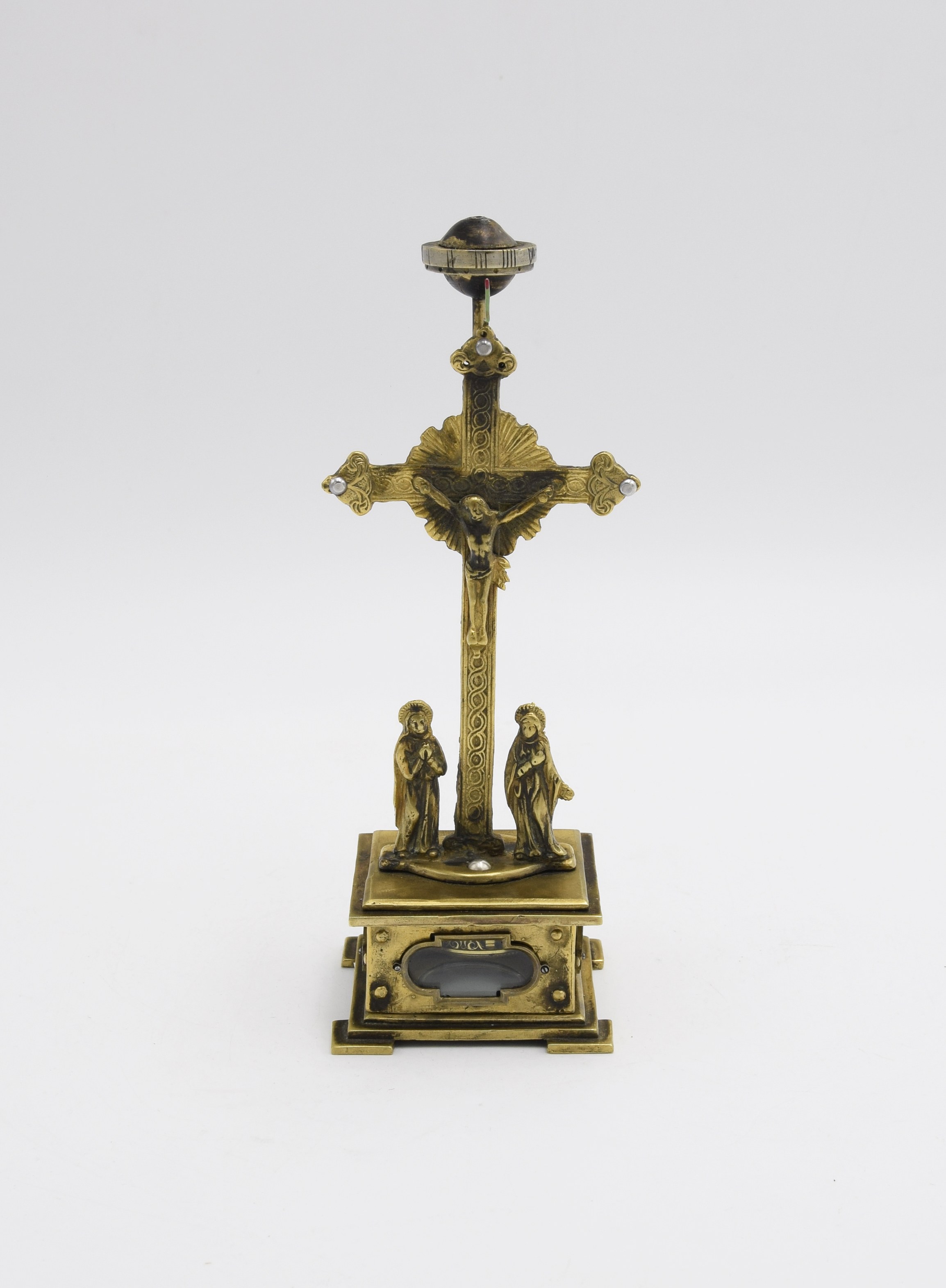
A rotating silver-plated dial with a scale (1-6). The free space filled with a vignette similarly decorated to a chignon, with a cut-out reserve, in which there is an engraved signature of the watchmaker.
State of preservation: secondary case, with numerous traces of repairs.
The case, characteristic of a tile clock, has a secondary mechanism removed from a pocket watch. The lower plate with a French-type chignon (more commonly used in England starting in the 1830s-40s) is covered with a characteristic ornament of ribbons and acanthus threads, which, with some compositional modifications, is found on Hally's clocks and carriage clocks dating to the 2nd quarter of the 18th century. The pasque is later, dating to the end of the 18th century, although, given the lack of fine artwork and carelessly made casting, it is very likely that it was made in the 19th century according to an earlier model. Also surprising is the choice of this particular form of case for the watch. Rotary clocks with a band appeared in the late 16th century in Germany, and reached the peak of their popularity until about the mid-17th century. By the 2nd half of the 18th century, they were practically no longer made.
Almost nothing is known about Thomas Hally except that he was certainly active in London and made pocket watches, carriage watches, brackets and cabinet-floor standing clocks [Miller's 1997, p. 46)}. The period of activity given by Britten [Britten 1977, p. 405] as the 1760s-70s is questionable in the context of surviving pieces and current knowledge. Baillie, on the other hand, states that Hally was active in London in the late 17th century. [Baillie 1951, p. 141]. Most of Hally's known clocks are now dated to the 1830s-50s. Records from The Commissariot Record of Edinburgh show a 1742 suit filed by Thomas Hally clockmaker of London" for the annulment of a marriage he had entered into in 1721, due to his wife being caught in flagranti with a soldier [https://mb.nawcc.org/threads/information--needed-about-thomas-hally-london-tall-clock.54943/ (accessed 12.VII.2021)].
Thomas Hally's clocks can be found in two Scottish residences: the Blaire Castle owned by the Murray family and the Dalyell residence House of the Binns. Several of his watches have appeared in auction houses, including a Sotheby's carriage watch of circa 1753 (auction of 6.07.2017, item 19), a Cogs and Pieces pocket watch of circa 1750 [https://www.cogsandpieces.com/pocket-watch-1345/ (accessed 12.07.2021)] and a Bonhams pocket watch of 1743 (auction of 10.VI.2015, item 2).








Vizualizate recent
Loghează-te pentru vedea lista loturilor
Preferate
Loghează-te pentru vedea lista loturilor