


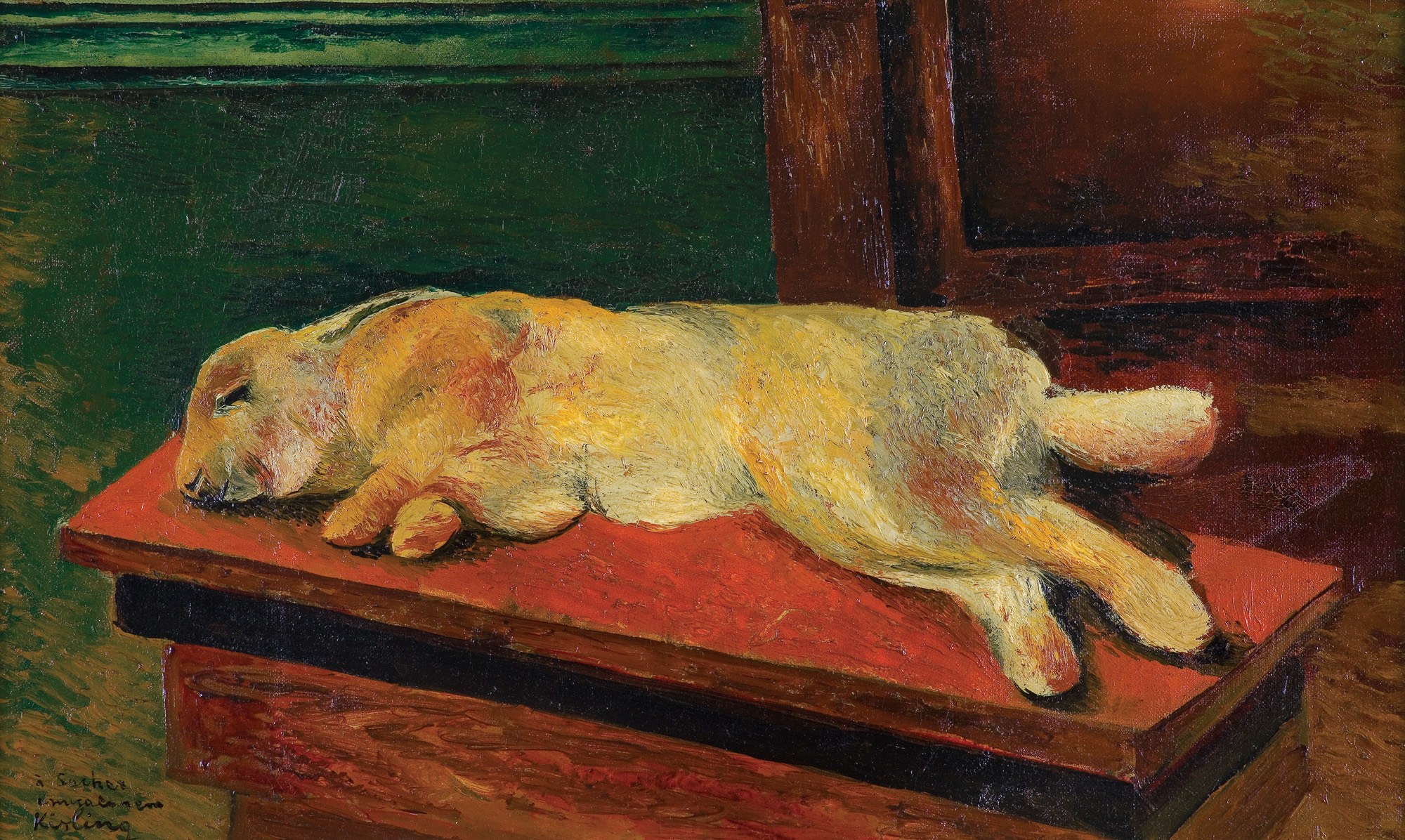
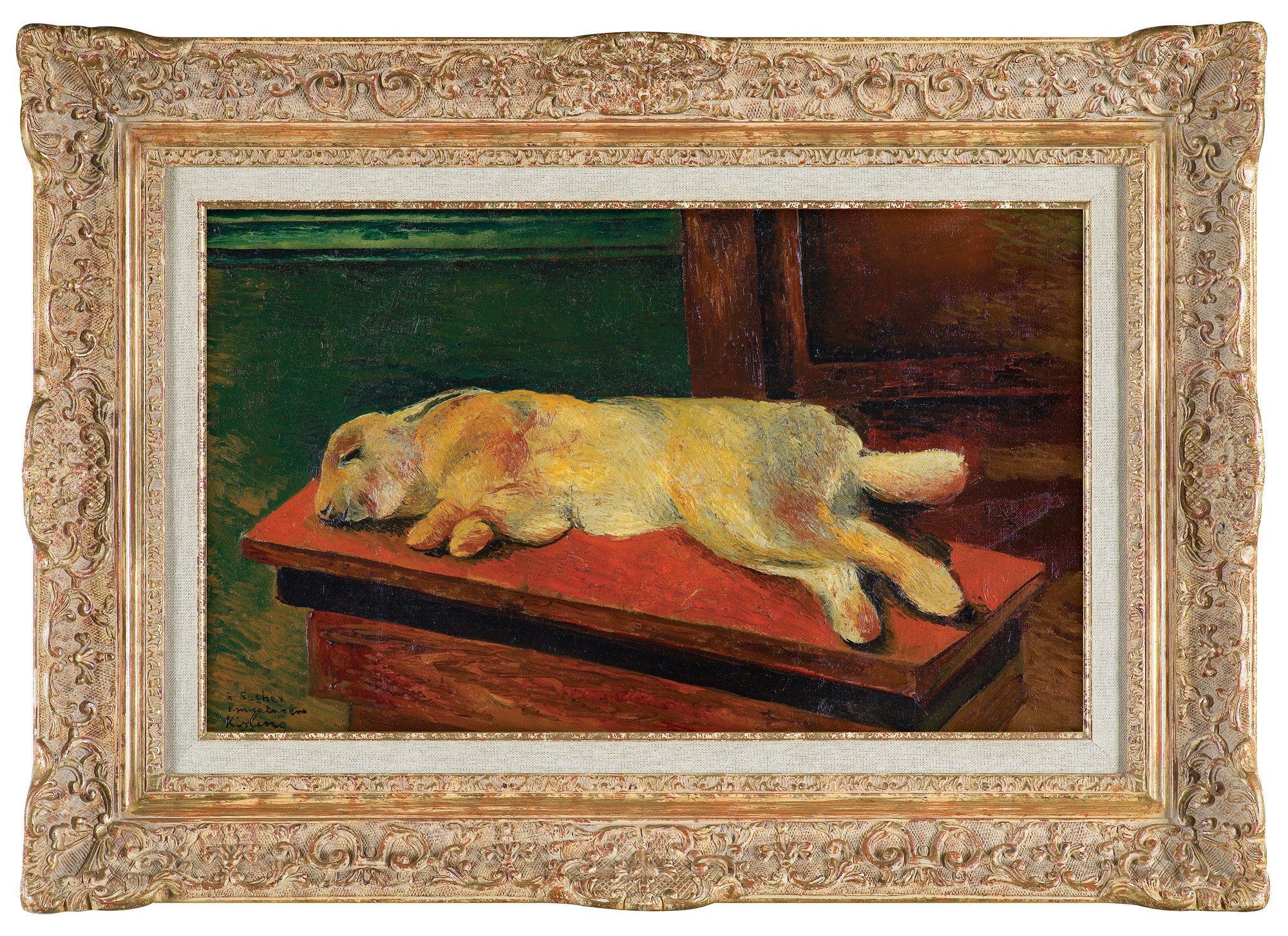
33.2 x 55.5 cm - oil on canvas
signed lower left: a Sacher amicalement Kisling
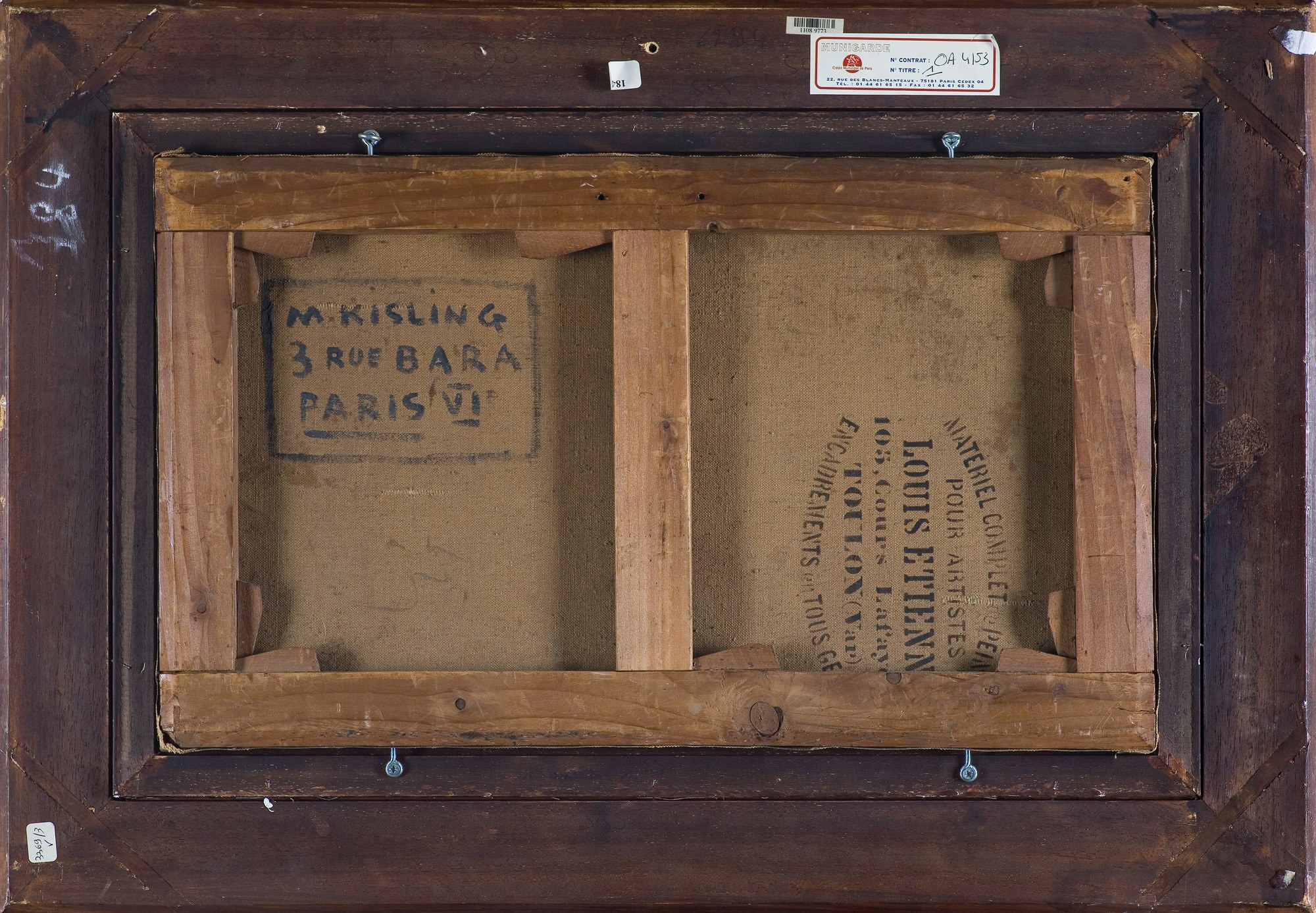
On the reverse, lower left (in paint): M. KISLING | 3 RUE BARA | PARIS VIe [in a frame];
bottom right, large oval stamp: MATERIEL COMPLET de PEINTURE | PUR ARTISTES | LOUIS ETIENNE |
103, Cours Lafayette | TOULON (Var) | FRAMING OF ALL KINDS;
on the right stretcher bar, a number referring to the size of the canvas (stamp): 10 Dem M;
in addition, auction labels on the frame.
The painting will be included in Volume IV (a supplement to Volumes I, II, and III) of the catalogue raisonné of Mojżesz Kisling by Marc Ottavi (in preparation).
The unique atmosphere of Kisling’s still lifes has been attributed to echoes of 17th-century Dutch painting. In his early career, the artist was influenced by Cézanne, and later by the Cubists. As a member of the École de Paris—an extremely diverse circle of artists active in Paris during the first decades of the 20th century—Kisling established contacts with, among others, Amedeo Modigliani, Chaim Soutine, and other artists associated with Montparnasse. Paris gave him the opportunity to engage with the most important movements in modern painting. His experiences with Post-Impressionism, Fauvism, and Cubism were particularly significant. Kisling remained open to these influences, yet he did not fully submit to any of them. He quickly developed his own style, characterized by pure colors, neutral backgrounds, and smooth, lustrous surfaces, as well as decorative linearity, particularly evident in his still lifes and floral compositions. His works also demonstrate that modernity does not necessarily mean a complete departure from reality. Kisling stuck with recognizable objects but transformed them in accordance with his own artistic language.
Cubism, Expressionism, pure Cubism—these are literary topics. I do not recognize any artistic movements; what matters to me is whether a painting is good or bad. The French, who possess the ability to precisely articulate their observations, speak of a painting in no other terms than: “C’est mal fait” or “C’est bien fait.” The secret of painting lies in that single word, “fait,” said Mojżesz Kisling.
“Wiadomości Literackie” 1926, no. 46, p. 1
Still lifes occupy a special place in Kisling’s oeuvre. They served as a field for painterly experimentation. By depicting flowers, fruits, vessels, jugs, or animals, the artist was able to move away from the necessity of faithfully reproducing reality and focus on constructing an autonomous composition. Objects became elements of a larger arrangement of colors, shapes, and lines. Color took on particular significance, serving a structural function that allowed the artist to establish a balance between individual elements. Light in his still lifes was not always depicted in a naturalistic manner. Rather than meticulously analyzing lighting effects, the artist prioritized conveying an overall sense of brightness and harmony. He used light to set individual objects apart from the background, emphasizing their form and creating contrast between different surfaces and planes.
Mojżesz Kisling’s still lifes are an important part of his body of work and demonstrate the painter’s interest in color, decorativeness, and compositional harmony. The artist did not need a grand subject to create a work that would capture attention. All he needed was an ordinary rabbit, light, color, and his own sensibility to create a unique and decorative work of art.
Mojżesz Kisling (1891, Kraków–1953, Sanary-sur-Mer) studied at the Academy of Fine Arts in Kraków under Józef Pankiewicz from 1907 to 1911. On Pankiewicz’s advice, he and Szymon Mondszajn traveled to Paris to continue their studies. There, the critics André Salmon and Adolf Basler took an interest in his work, and he also received a scholarship from an anonymous patron in Russia. During World War I, he fought in the Foreign Legion. He was wounded during combat on the front lines and was discharged from the army in 1915. It was likely at that time that he obtained French citizenship. Beginning around 1920, he began spending his summers regularly in Sanary-sur-Mer, where he bought a house. He also maintained ties with his homeland. During World War II, he enlisted in the French army. In 1940, he traveled via Spain and Portugal to New York. After the war, around 1946, he returned to Sanary-sur-Mer. He was one of the most prominent representatives of the École de Paris during the interwar years. He held numerous solo exhibitions and frequently participated in group exhibitions abroad as a Polish artist. He also took part in the domestic art scene, including the First Exhibition of Polish Expressionists (later known as the Formists) in Kraków in 1917. He was friends with Tadeusz Makowski. In his early period, he painted Cubist-style landscapes and still lifes. Portraits were a recurring theme in his work, including numerous depictions of artists, critics, and figures from artistic circles, thanks to which he became a chronicler of the Ecole de Paris social scene. His portraits of women and nudes are characterized by a distinctive stylization; they feature idealized faces with large eyes and strike carefully studied poses.













Vizualizate recent
Loghează-te pentru vedea lista loturilor
Preferate
Loghează-te pentru vedea lista loturilor