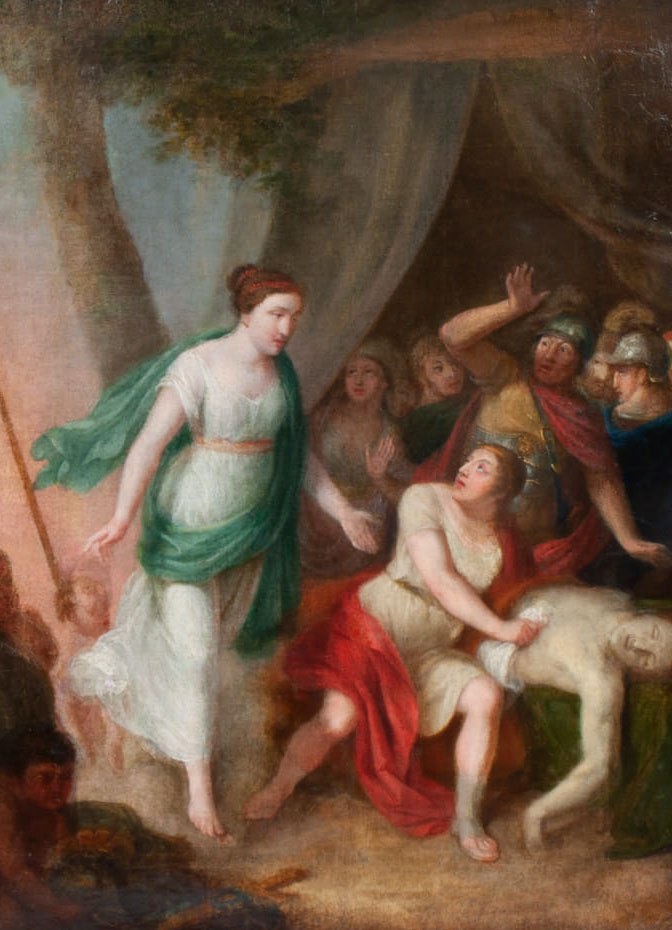
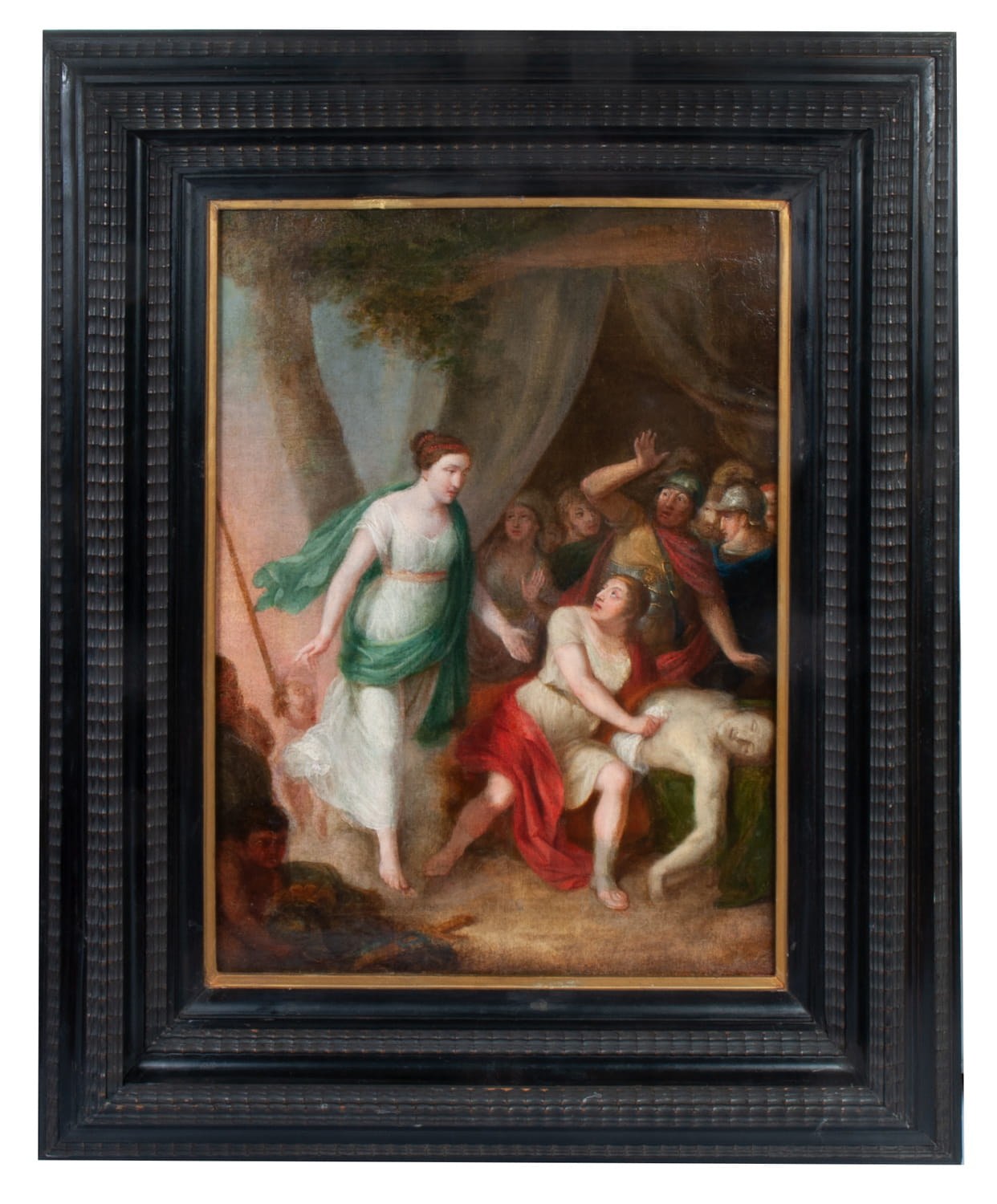
Oil on double-layered canvas, inscribed on the reverse: “Achille, Patrocle, Thetis; Esquisse par Jos. Pitschmann”.
Dimensions with frame: 90x74 (62.5 x 47 cm)
Józef Pitschmann (Trieste 1758–1834 Krzemieniec)—painter, primarily a portraitist. He was educated at the Vienna Academy under the guidance of Johann Baptist Lampi, Heinrich Friedrich Füger, and Heinrich Carl Brandt. In 1787, he received a gold medal in a painting competition for his work *Hercules Returning the Freed Alcestis to Admetus* and became a member of the academy. His Viennese period includes pastel landscapes depicting pastoral scenes (1783), which are currently housed in the art gallery in Lviv. In 1788, he arrived in Poland at the invitation of Józef Klemens Czartoryski and lived until 1789 at the latter’s estate in Korec, Volhynia, working as a portrait painter and drawing instructor. From 1789 to 1794, he resided in Warsaw. During this period, the painter spent several months in Poznań. In the capital, he gained recognition as a portraitist among the middle-ranking nobility and the bourgeoisie. He also left behind several portraits of Stanisław August; for one of them, the monarch rewarded him with a diamond ring in 1794. On March 11, 1791, Pitschmann married Agnieszka, the daughter of Jan Baudoin de Courtenay, a writer and mesmerist physician. The years 1794–1806 marked his Lviv period, during which he painted approximately 300 works, mainly portraits. He gained popularity among the aristocracy, the nobility, and government officials. During this time, he also painted portraits of Emperor Francis II and his wife, commissioned by Lviv Archbishop Kajetan Ignacy Kicki. In 1806, he moved permanently to Krzemieniec, where he lived until the end of his life. He was appointed by Tadeusz Czacki to the position of drawing instructor at the Krzemieniec High School and also gave private lessons. During this period, he created approximately 150 paintings (mainly portraits of high school professors and the Volhynian nobility). Among them are portraits of Euzebiusz and Salomea Słowacki (both at the Adam Mickiewicz Museum of Literature in Warsaw) and Teofil and Hersylia Januszewski (at the National Museum in Wrocław). On the occasion of his twenty-fifth anniversary of service, he was awarded the honorary title of councilor; he was also twice awarded medals: a gold medal with a red ribbon from the emperor, to be worn around the neck, and a bronze medal awarded exclusively to the nobility of the Empire (1812). Among his students were painters such as Bonawentura Klembowski and Jan Ksawery Kaniewski. In the early period of his career, Pitschmann often painted mythological and historical scenes. He worked in the spirit of late Classicism. In addition to oil painting, he also worked in pastels.