


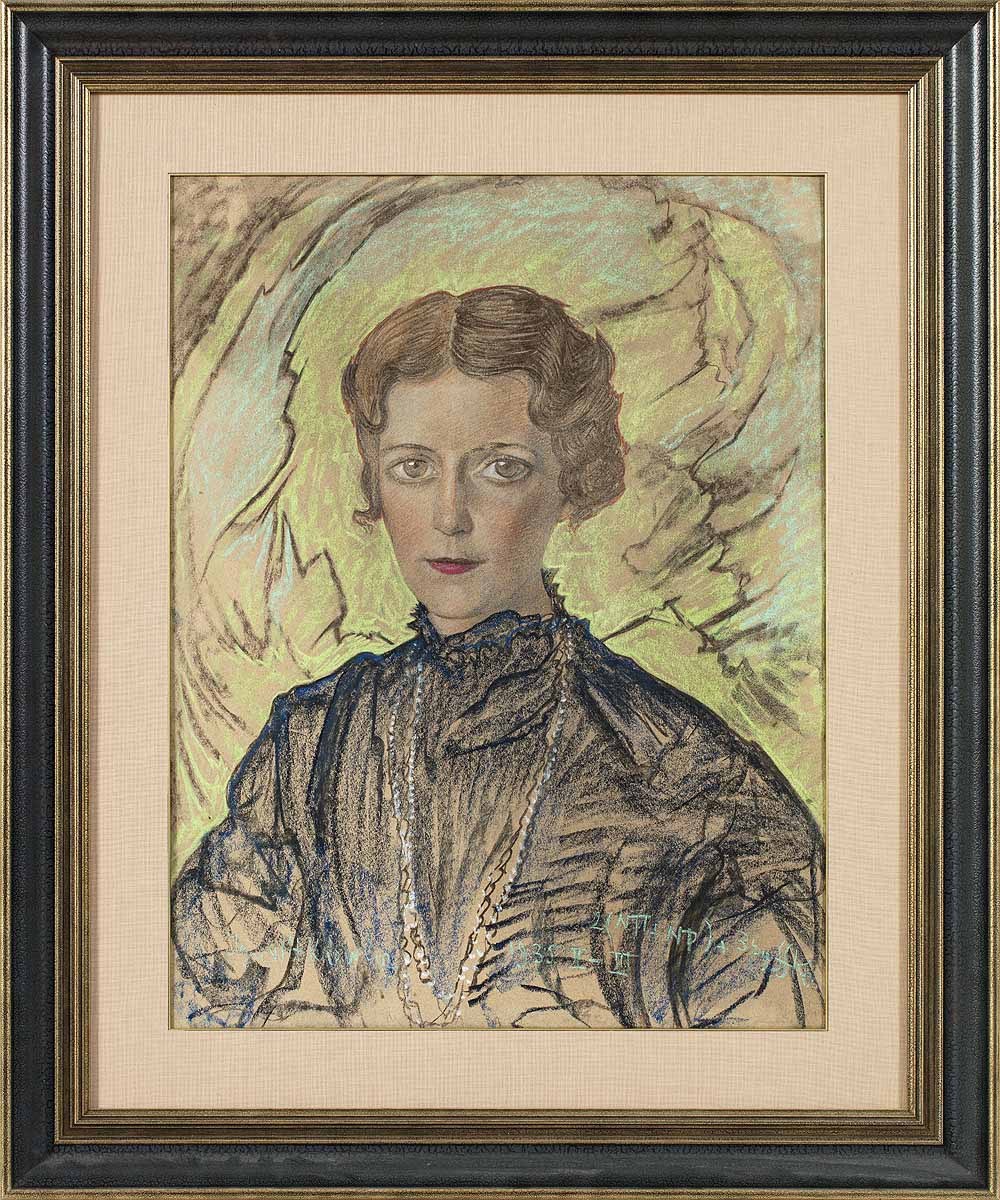


Dimensions: 63 x 48 cm (in light of frame)
Signed: signed l.d.: Ign Witkiewicz, inscribed at the bottom: 2 (Nπ + NP) + 3pyffko / 1935 II-III, on the reverse of the binding a paper ownership sticker: Portrait / Wanda Orłowska / Owner / Zdzisław Orłowski / Poznań - Zakręt Street ... (in pen), part of the inscription crossed out and overwritten in blue ink: Julia Michalska / Kasprzak (ballpoint pen) and annotation: IGNACY WITKIEWICZ 1935(II-III) / Zofia Januszkiewicz (ballpoint pen, black ink).
Provenance
France, Rempex private collection, auction 09 .02.2022, item 1 Minsk Mazowiecki, collection of Wanda Orlowska Poznan, collection of Wanda and Zdzislaw Orlowski
Literature
Korduba P., Paradowska A., Na starym Grunwaldzie. Houses and their inhabitants, Posnania City Publishing House, Poznań 2012, pp. 112-114.
Witkacy devoted himself entirely to the art of portraiture after 1925. Disappointed with the reception of his previous work, he abandoned easel painting and established the "S.I. Witkiewicz" Portrait Company, encased in detailed regulations defining both the typology of portraits and the rules of work. Many realizations were created under the influence of intoxicants, alcohol or drugs - and the artist meticulously recorded his mental and physical state in the form of an authorial code placed on the work.
The presented portrait shows Wanda Orlowska, the wife of Major Zdzislaw Orlowski and one of the most beautiful residents of Poznan's villa district. According to the authors of a study on the city's former architecture, she was distinguished by her "extraordinary class and uncommon beauty." Witkacy even had the habit of waiting for her in the dining room of his Zakopane boarding house, staring at her demonstratively - Orłowska was one of his favorite models, and the subsequent portraits commissioned by the major were a reliable and regular source of income for the artist. It is known that she also posed for other esteemed artists, including Kazimierz Jasnoch and Rudolf Krzyzak, who was specially brought from Zakopane to create a representative portrait of her (See: Korduba P., Paradowska A., Na starym Grunwald. Houses and their inhabitants, Poznań 2012, p. 112).
From her first husband, banker Bogdan Rajewski, Wanda Orłowska inherited a significant art collection. Wartime turmoil, however, forced the Orlowski couple to leave the country at the dawn of World War II. Their collection was taken to Minsk Mazowiecki with the hope that it would safely survive the wartime cataclysm there. Unfortunately, it ended up in Warsaw during the occupation and was completely destroyed during the uprising. This makes the offered portrait of Witkacy all the more important - from both a collector's and historical perspective. Most likely from the original Orlowski collection, it is among the few surviving works associated with the family.
The artist depicts Orlowska as an elegant woman with large, penetrating eyes, wearing a black gown and a long string of pearls, with her hair styled in fashionable waves. The drawing bears an annotation indicating that she had not drunk or smoked for two days prior to starting work ["2 (Nπ + NP.)"], after which she drank three beers at a time ["3pyffko"]. The portrait does not have a letter designation of one of the official types of the Portrait Company, however, stylistically it is closer to Type B - "more characteristic, but devoid of caricature, cartoonish, allowing for 'niceness' in female portraits" - or Type E, based on "any psychological interpretation." Two other images of Orlowska, dated 1930 and 1935, are also known to have been made precisely in B and B+E types.










