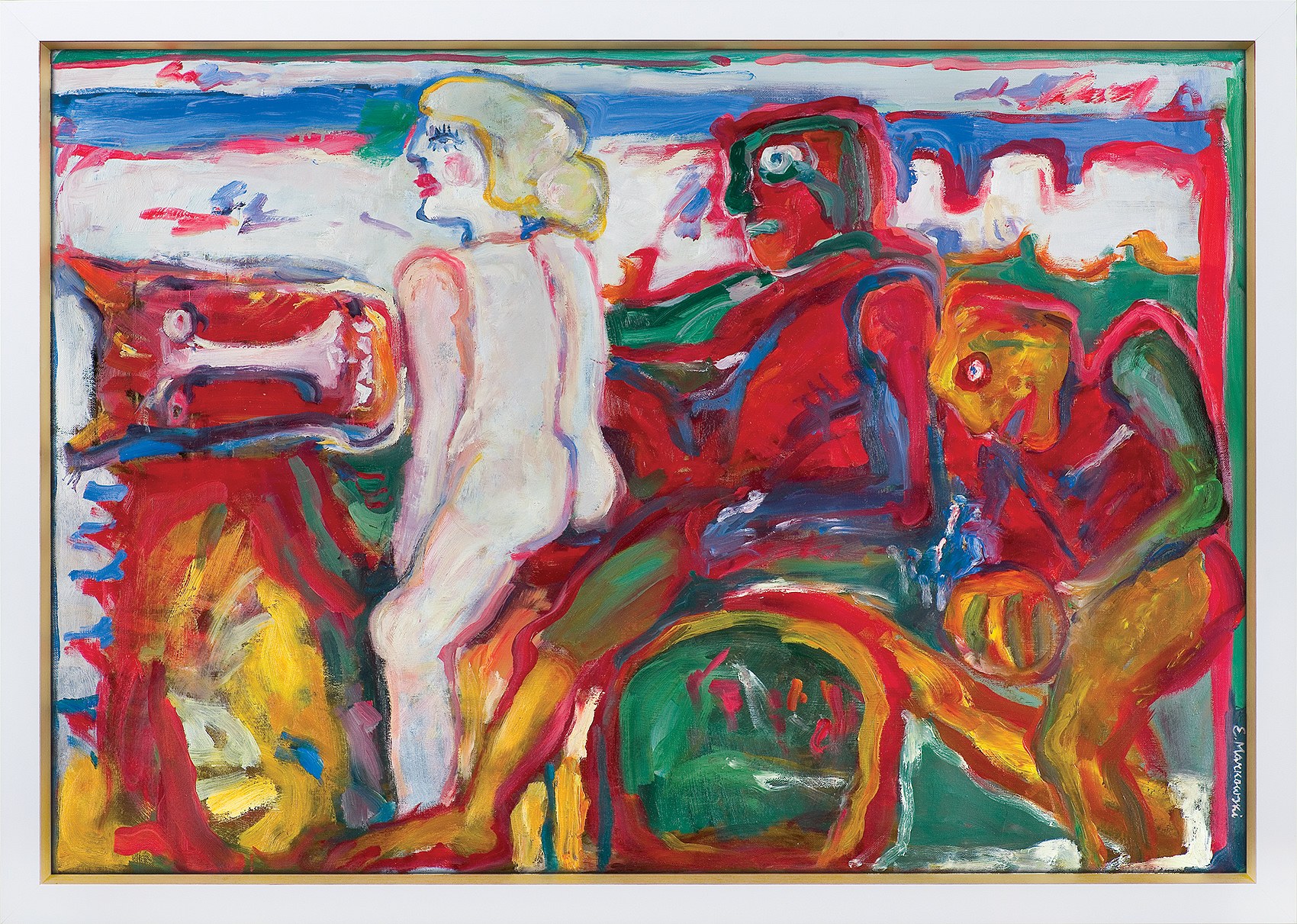

Sign. along p. edge at bottom: E. Markowski
Sign. on reverse on canvas at p. edge: E. Markowski
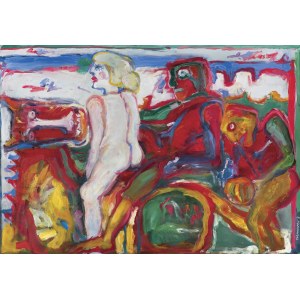
on g. loom strip in red paint: 1982 "AMAZONKA +1+2", on p. loom strip: ol. 67 x 98
Eugeniusz Markowski is primarily interested in passions in painting. He reveals them through caricatured human figures. In his paintings, man usually appears physically naked and at the same time mentally exposed. The figures in his paintings struggle with each other, entwined in an embrace tug at each other in a wild fight. The man is repeatedly accompanied by an animal - a horse or bull. The horse, with its characteristic massive, strongly outlined figure, seems to personify human emotions.
Markowski repeatedly takes up the same subjects, creating paintings with analogous titles, but differing in elaboration of details and dimensions.
The artist explains the alchemy of his workshop this way: Workshop, painting matters are also my passions. A subject alone would not be enough for me to work on. My ideas are the raw material from which I can only make a painting. The form in art is as important as the idea. It is a unity. That's why I can work on a painting for ten years, repainting it a dozen times. When I start painting, things that are already beyond the idea become more important. I am passionate about color and painting matter. I look for the most apt arrangement and composition.
♣ to the auctioned price, in addition to other costs, will be added a fee resulting from the right of the creator and his heirs to receive remuneration in accordance with the Law of February 4, 1994 - on copyright and related rights (droit de suite)
Eugeniusz Markowski (Warsaw, November 8, 1912 - Warsaw, February 24, 2007) studied at the Warsaw Academy of Fine Arts, receiving his diploma from Professor Tadeusz Pruszkowski in 1939. He took part in the September campaign and the defense of Warsaw. From 1940 to 1950 he was in Italy, where he was associated with the Libera Associazione Arti Figurative group and the Art Club in Rome. He was also involved in designing sets for Rome's Teatro delle Arti. He was a journalist and diplomat in Italy and Canada (1945-1955). After returning to Poland, he was director of the Office of Cultural Cooperation with Foreign Countries at the Ministry of Culture and Art (1960-1969), then lecturer and professor at the Academy of Fine Arts in Warsaw (1969-1984). He co-worked as a stage designer with the Gdansk Opera and Warsaw theaters. In 1963 he represented Poland at the Sao Paulo Biennale and had several solo exhibitions. His expressive style of painting, directness and a certain rubbishiness of his figurative representations of fights and struggles caused him to be considered a forerunner of the "novae" in the 1980s.