




Joseph Pressmane (1904–1967)
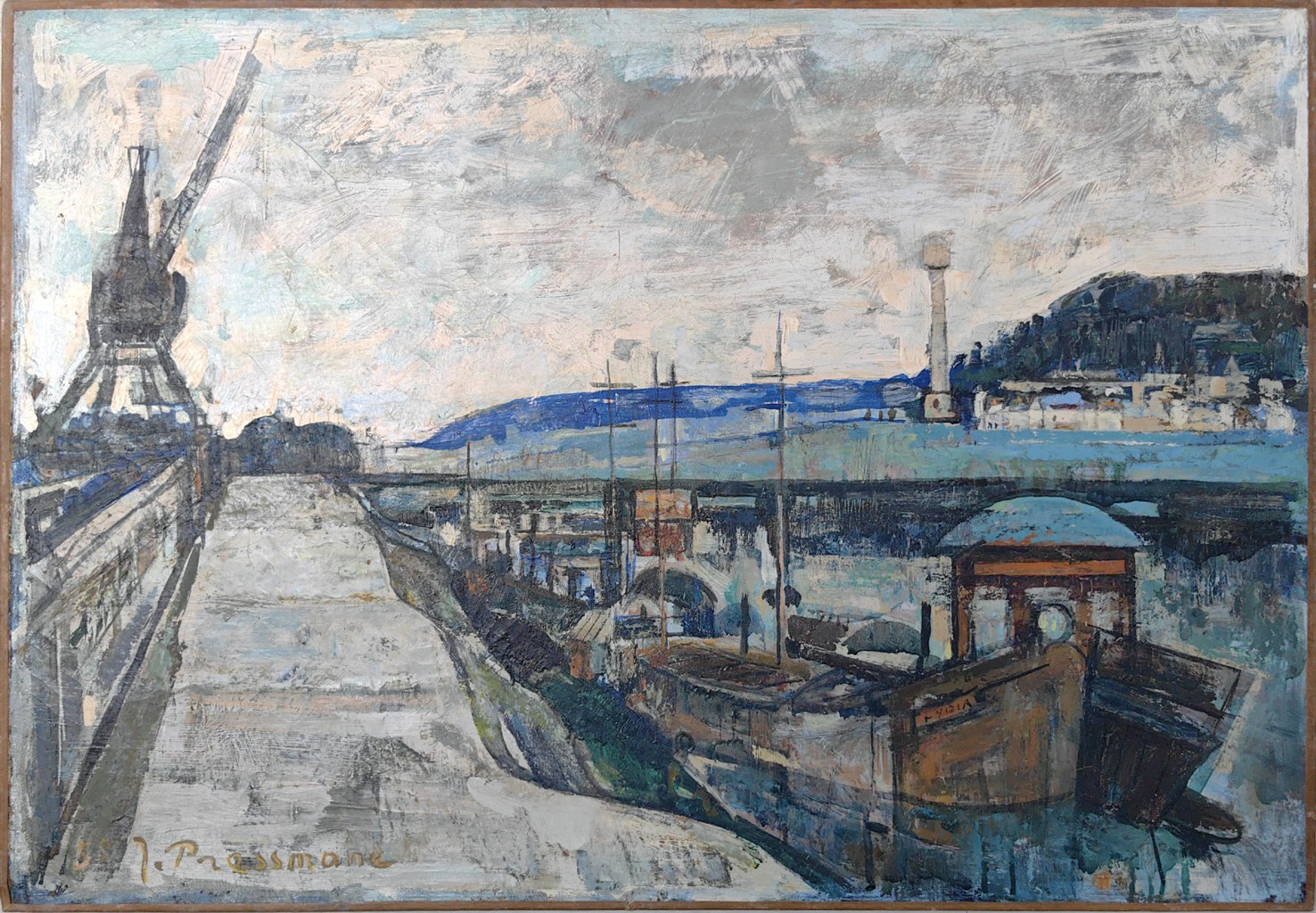
River Port – Creil, 1958
Oil on canvas
Dimensions: 50 × 73.5 cm (+ frame)
Signed and dated lower left: 58 J. Pressmane
Provenance: private collection, Israel
The work depicts a harbor landscape in Creil—a French town on the Oise River—captured in Pressmane’s characteristic style, which combines expressive brushstrokes with a subtle interplay of colors. The reduced color palette, the dominance of blues and grays, and the loose brushwork create an atmosphere of tranquility and gentle melancholy.
Joseph Pressmane, a Polish-French painter associated with the École de Paris, became famous for his portraits and landscapes, in which he combined the tradition of the Paris school with his personal sensibility. In the 1950s, the artist frequently explored urban and river landscapes, imbuing them with a poetic and intimate character.
Joseph Pressmane (1904–1967) was a painter and printmaker of French-Polish descent associated with the École de Paris. He was born in Warsaw, where he began his artistic education. He studied at the Academy of Fine Arts in Lviv and later continued his studies in Warsaw. His first solo exhibition was held in 1925 in Jerusalem, where he moved after completing his studies. A year later, he moved permanently to Paris—the center of the art world, which had a decisive influence on his artistic development.
In Paris, Pressmane began working for the renowned Académie Ranson, gaining recognition in artistic circles. He primarily created portraits and landscapes that stood out for their distinctive expressiveness of form and color. His works conveyed intense emotions and a deep sensitivity to the surrounding world. Leopold Zborowski, a respected Polish art dealer and poet, became an early patron of the artist; he collected his works and supported him in the early stages of his career.
Pressmane’s style was firmly rooted in the tradition of the École de Paris, yet it also reflected the artist’s individual experiences. In his works, he was able to capture human emotions and the unique beauty of everyday life. His work quickly gained recognition both in Paris and abroad. He exhibited in prestigious galleries, and his name became well-known in artistic circles.
The years of World War II were a difficult period in Pressman’s life. He went into hiding from the German occupiers, which influenced the melancholic tone of his later works. After the war, he returned to his art, which became more reflective and profound, often reflecting the loneliness of the individual in a complex world.
Joseph Pressmane died in Paris in 1967, leaving behind a rich artistic legacy that continues to inspire subsequent generations. His paintings, full of passion and emotion, can be admired in museums and private collections around the world. Thanks to his exceptional talent and the support of patrons such as Zborowski, Pressmane established himself as one of the most outstanding representatives of the École de Paris, bringing an unforgettable sensitivity and intensity of expression to the group.










