


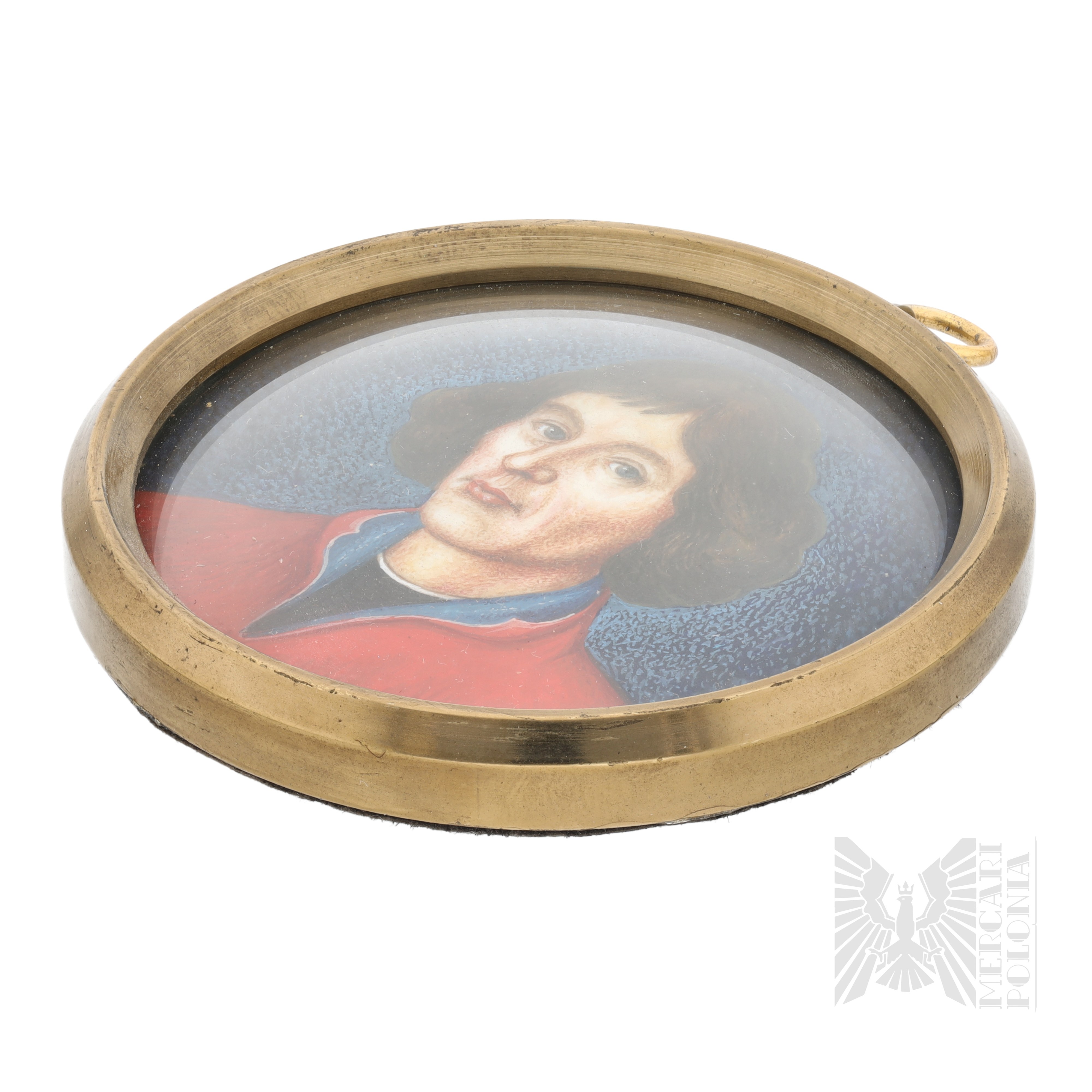

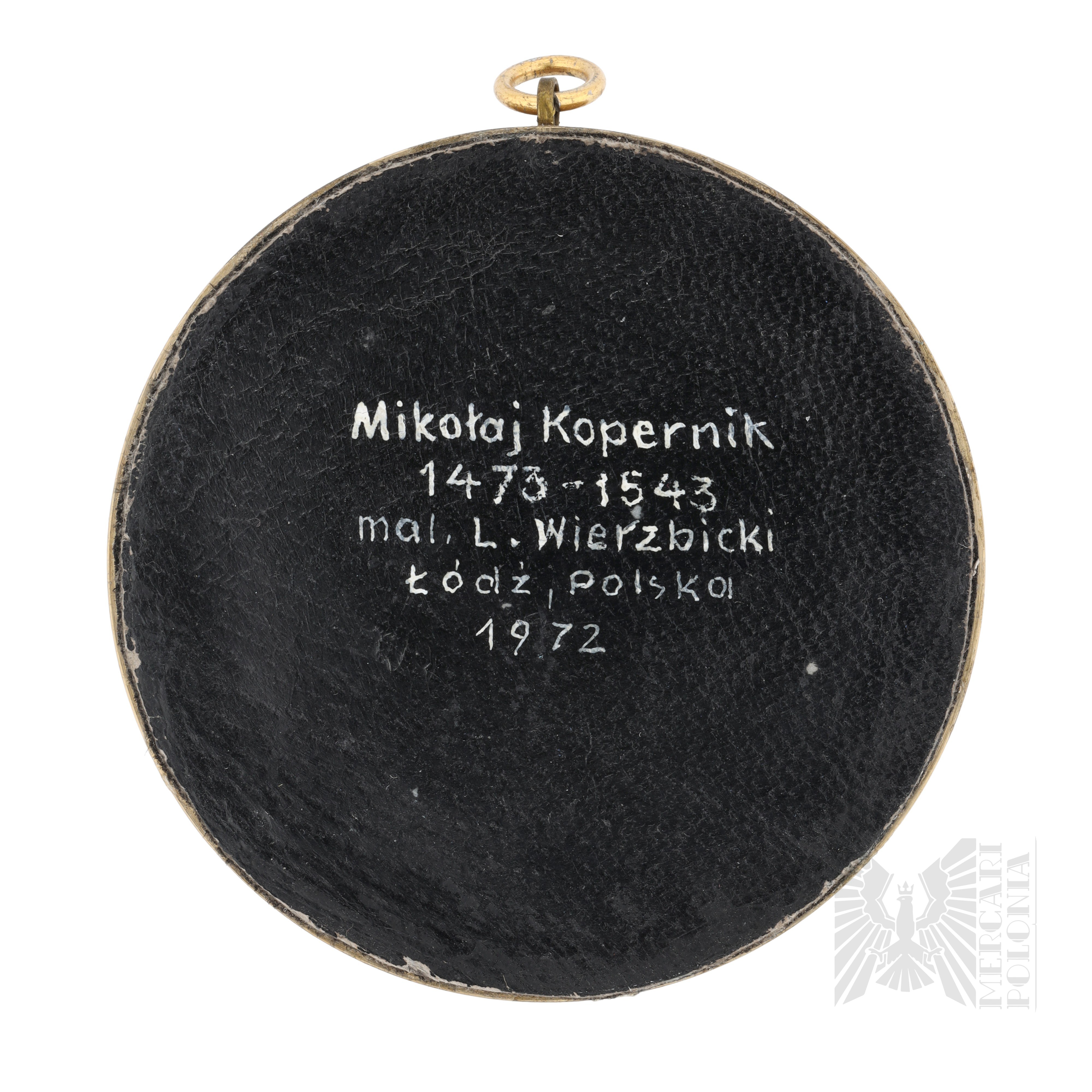
Portrait of a giant of the Renaissance by Leszek Wierzbicki, painted in Lodz, Poland, in 1972. The miniature is a version of a 16th century portrait of Toruń's Nicolaus Copernicus. The miniature, in the form of a round medallion, is framed in a simple golden metal frame, equipped with a small ear for hanging. Inside, under a layer of glass, is a painted portrait of the scientist framed en face, with his head gently turned. The background is in a cool, bluish tone, slightly grainy, contrasting with the warmer color of the robe. On the back of the binding is an identifying description: "Nicolaus Copernicus 1473-1543, mal. L. Wierzbicki, Lodz, Poland 1972".
Gouache on paper, in a round brass frame behind glass sealed with black cloth
Dimensions: diameter: 6,5 cm
Condition as in photos
The presented miniature is an example of the 20th century reception of the iconography of one of the most eminent scholars of the Renaissance era - Nicolaus Copernicus. The image clearly refers to the 16th century representations of the astronomer, known from the traditions of Torun and Northern European painting, which perpetuated his characteristic physiognomic type and the way he was depicted in half pose. The whole work has the character of a small, finely crafted collector's object.
Lech Wierzbicki's work is part of the current of post-war interest in ancient art and its reinterpretation in chamber forms. Miniature portraits, especially in medallion settings, were a popular form of commemorative and collector's art during this period, combining aesthetic qualities with educational and patriotic functions.
The year 1972 - the time of the work's creation - preceded the celebration of the 500th anniversary of Copernicus' birth (1473-1973), which further explains the increased interest in his figure in the visual culture of People's Poland. The work can therefore be interpreted as a testimony to both the continuity of the iconographic tradition and the contemporary (for the time of its creation) need to commemorate a figure of fundamental importance to science and the cultural identity of Europe.











Vizualizate recent
Loghează-te pentru vedea lista loturilor
Preferate
Loghează-te pentru vedea lista loturilor