
Dimensions: 152 x 152 cm
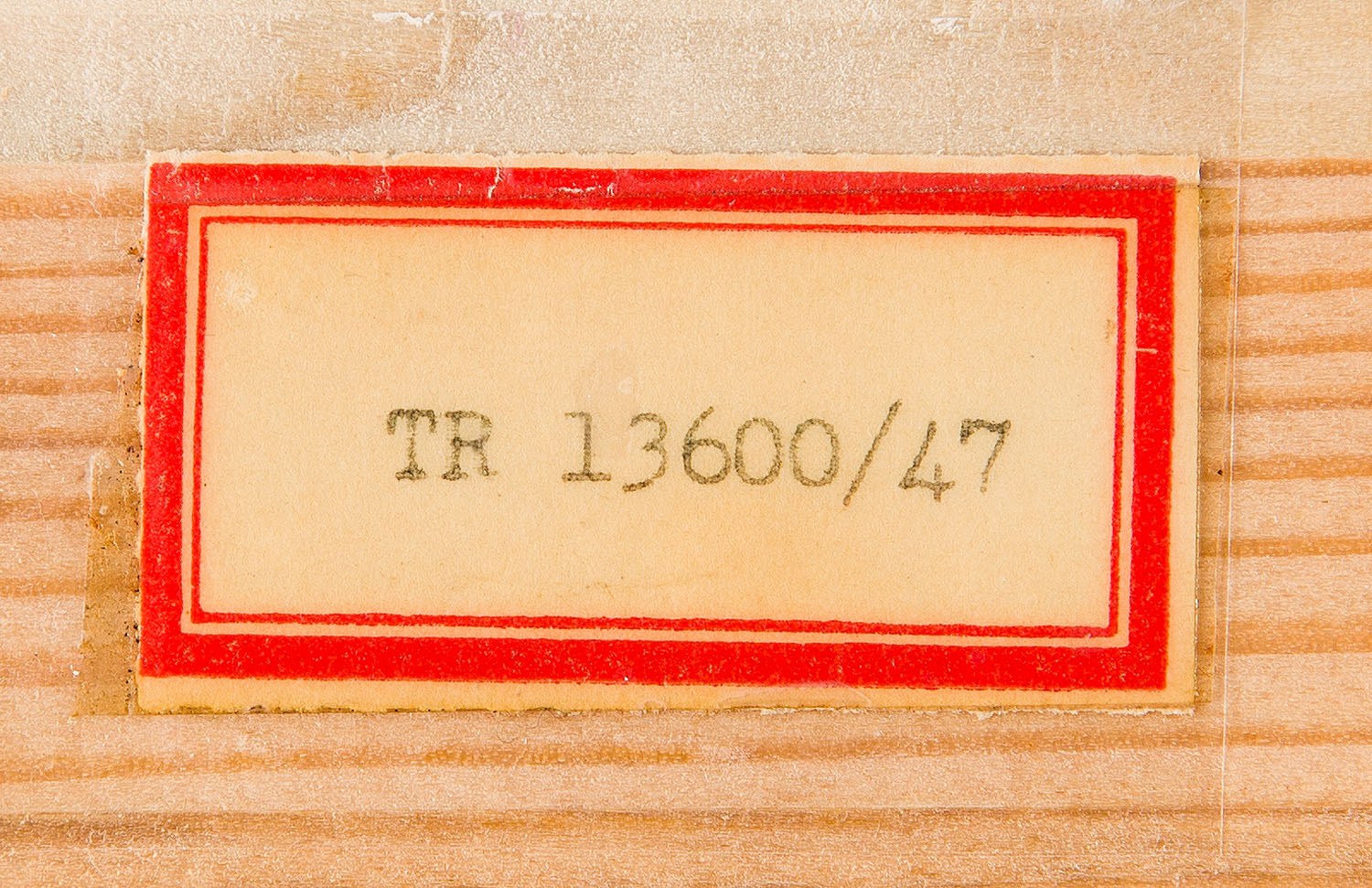
label with inventory number on the easel
Provenance
Martha Jackson Gallery, New York
Private collection, New York
Christie’s, 2018
Private collection, Poland
Biography
The artist earned his higher education at the Carnegie Institute of Technology in Pittsburgh from 1954 to 1958. He took classes in the lithography studio, where Ed Mieczkowski served as an assistant; their shared passion for drawing brought them together. In 1960, together with Ernst Benkert, they founded the Anonima Group, an artistic collective. He continued his studies at Oberlin College, where, in Charles Parkhurst’s class, he took a course on the history of color that had a significant influence on his later work. Between 1960 and 1964, he attended a technical drawing course at the Cleveland Institute of Art alongside Mieczkowski, while also studying aesthetics and the psychology of perception. In the second half of the 1960s, he traveled extensively throughout Europe, visiting, among other places, Paris, Warsaw, Kraków, and Zagreb. One of his paintings was included in the famous Op Art exhibition “The Responsive Eye” at MoMA in 1965. Upon his return to New York, he continued his collaboration with the Anonima Group and began teaching at the Pratt Institute. In the early 1970s, he moved to Vermont, where he taught at the local university until 1992. That same year, three months after the artist’s death, a monumental retrospective exhibition of his work was held at the Robert Hull Fleming Museum in Vermont. Hewitt’s works are included in the collections of, among others, the Cleveland Museum of Art, the Museum of Modern Art in Caracas, and the Museum of Art in Łódź. In 1966, works by artists from the Anonima Group were exhibited at the Foksal Gallery in Warsaw as part of the exhibition “Black-and-White and Gray Images.” The Foksal Gallery, which presented such radical exhibitions in communist Poland, was considered one of the most important venues for avant-garde art in the world.