


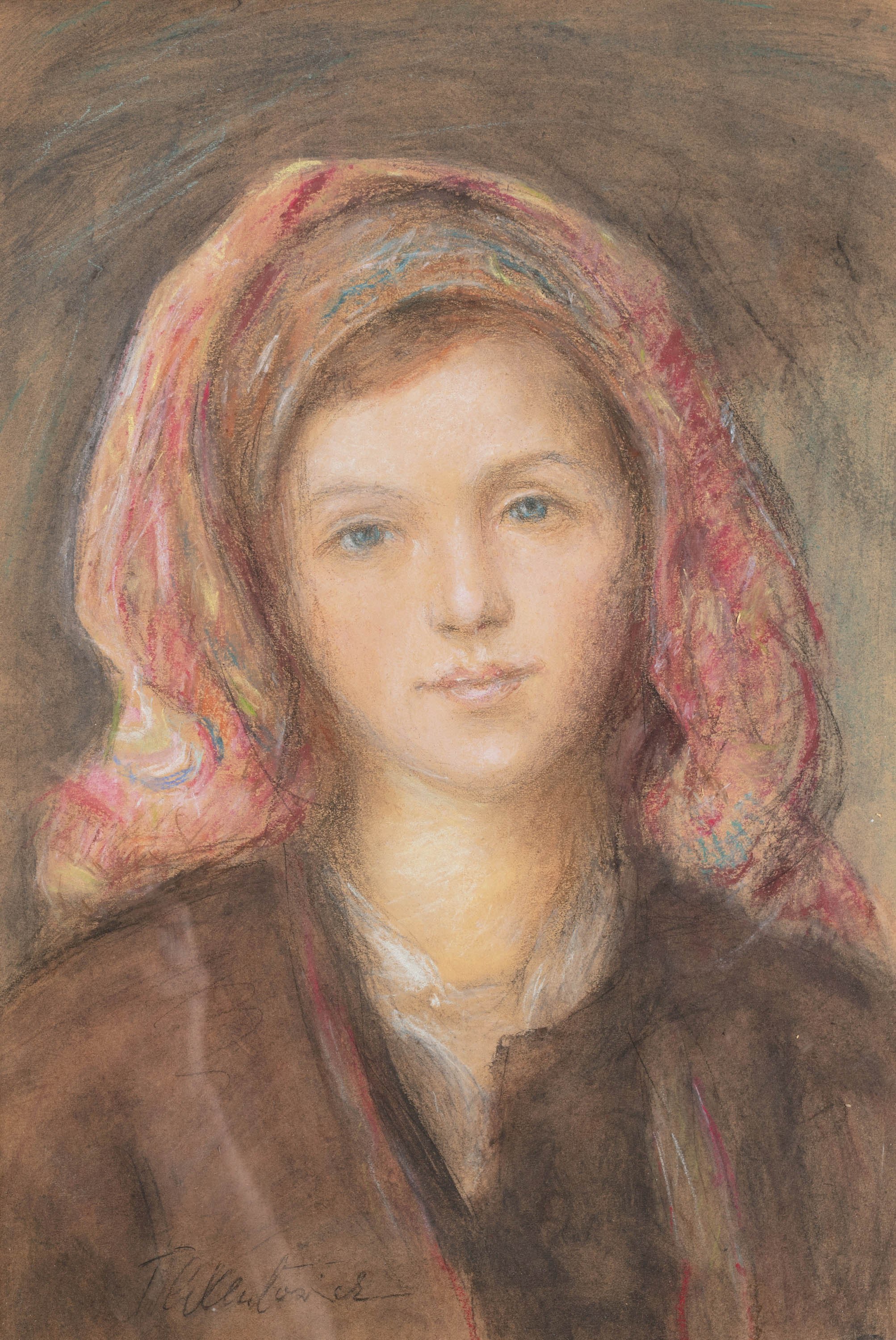
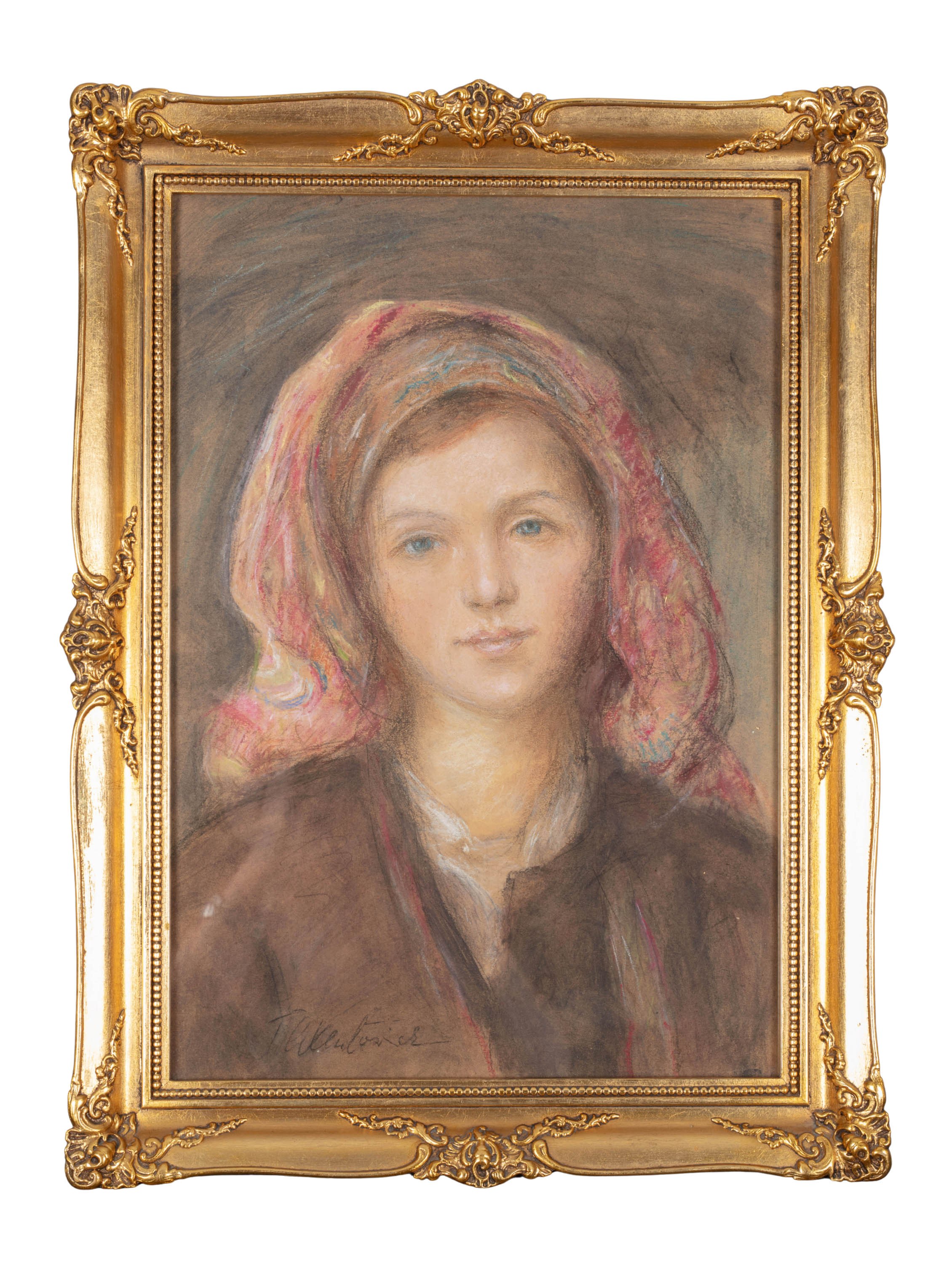

pastel on paper, 47.5 x 32.5 cm (inside the frame)
signed lower left: "T. Axentowicz"
“It is interesting that this boudoir painter is strongly drawn to and captivated by folk motifs, which he treats with genuine affection, especially Russian motifs, shimmering with a play of colors that, under Axentowicz’s brush, soften, lose their vividness and variegation, and become a palette full of serene harmony.” (A. Chołoniewski, “In Axentowicz’s Studio,” in *Świat*, 1906, no. 12.)
“In Poland, over the course of half a century of work, Axentowicz created a vast gallery of the feminine beauties of his era, which serve as documents characterizing people and times, much like the works of Watteau and Boucher in France. Axentowicz, with remarkable alacrity and without losing his artistic qualities (“mâle du siècle”)—his mastery of color and refined painterly form—succumbed to the prevailing craze of the time for folk art, alongside Wyspiański, Tetmajer, and Stanisławski. The painter of Parisian boudoirs sets off for the polar opposite of Paris—a Hutsul village—enthusiastically embracing the picturesque regional character of the Hutsul region with the same sincerity he had shown toward Paris. During this period, driven by a call of the blood, Axentowicz demonstrated in his paintings a genuine Sarmatian romanticism and an emotional attachment to folk motifs, which he treated with great seriousness and sincerity. Axentowicz created furious obereks and sentimental Hutsul funerals, sparking enthusiasm and expanding his circle of admirers to all strata of society. (M. Dienstl-Dabrowa, “Teodor Axentowicz 1859–1938,” catalog of the posthumous exhibition, Kraków, 1939, p. 8.)










Vizualizate recent
Loghează-te pentru vedea lista loturilor
Preferate
Loghează-te pentru vedea lista loturilor