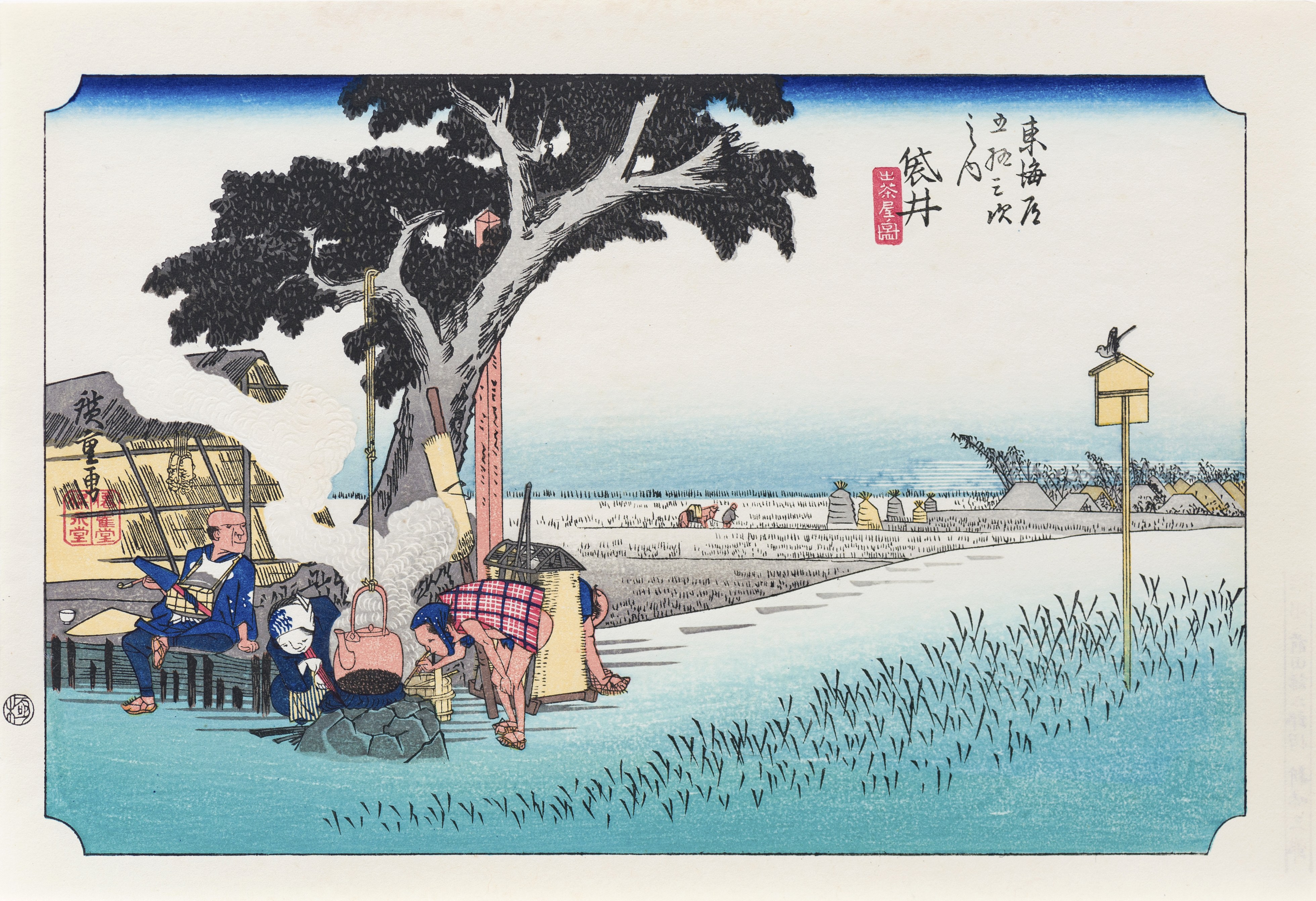
color woodcut, ink on paper, 22.5 x 33 cm, signed by the artist; on the reverse, a seal bearing the names of the artisans: carved by Kentaro Maeda, printed by Saburo Shinmi.
In the Fukuroiarea , the highway ran through desolate fields, and traveling along it during the summer months was uncomfortable. However, the area was famous for its strong winds in winter, when flying kites was a popular pastime among the locals. On the left, you can see a simple shelter where a traveler sits and rests, smoking a pipe. Straw sandals—an essential item for travelers—hang from the roof of the shelter. In the foreground, under a large tree, a group of travelers is resting. What immediately catches the eye is a simple hearth built of stones and a huge kettle suspended above it. The smoke rising from the hearth is rendered very effectively through the use of the “bokashi” gradation technique. A woman tends to the hearth and stokes the fire, while one of the peasants lights his pipe beside it. A signpost stands right next to a tree, and on the right, a bird perches on a roadside bulletin board; behind them stretch rice fields and a village.
The Fifty-Three Stations of the Tōkaidō is a series of 55 woodblock prints depicting the 53 post stations (shukuba) and two important points along the route: the starting point—the Nihonbashi Bridge in Edo—and the endpoint—the great Sanjo Bridge in Kyoto. The road stretched over 500 kilometers, connecting the shogunate’s capital with the old imperial capital. The fifty-three stations served as rest stops for horses and porters, as well as lodging, restaurants, and geisha houses for travelers who, under favorable weather conditions, could cover this distance on foot in two weeks. Among these travelers were feudal lords (daimyō), who were required to stay at the shogun’s court every two years and travel there and back in massive processions.
In 1832, Hiroshige traveled with an entourage of shogunate officials from Edo (Tokyo) to Kyoto along the Tōkaidō. This journey was an eye-opening and life-changing experience for him. After the trip, he returned to Edo and began work on a series of woodblock prints based on the sketches he had made. Published in 1833–1834, the series *Fifty-Three Stations of the Tokaido* (Hoeido Tokaido), published in 1833–1834, earned Hiroshige immense acclaim from both critics and the public. He skillfully captured atmospheric and mood-filled weather conditions, depicting fog, rain, snow, and evening lighting effects. He balanced these poetic landscapes by adding figures, which serve as a personal element in these works. The series offers viewers the opportunity to travel back in time to Hiroshige’s Japan under the Tokugawa shogunate and to see that life as the artist experienced it. The series became so popular that its constant reprinting during the Edo period led to the complete destruction of the first-edition printing blocks.
Ukiyo-e woodblock prints have been reprinted several times since the Edo period, always using the traditional method. From the early 20th century onward, the Yuyudopublishing house distinguished itself as one of the finest publishers in Japan. It adhered to the same rigorous standards as 19th-century publishers, while some of its peers cut corners. In the 1950s, when interest in Edo-period woodblock prints resurged, Yuyudo launched a project to reprint the works of the great masters from the golden age of ukiyo-e. To this end, they hired the world’s finest printers and woodcarvers. The resulting works are among the highest-quality editions ever produced. Yuyudo’s woodblock prints are exceptionally well-crafted and meticulously detailed. The publishing house ceased operations and stopped publishing in the 1980s.